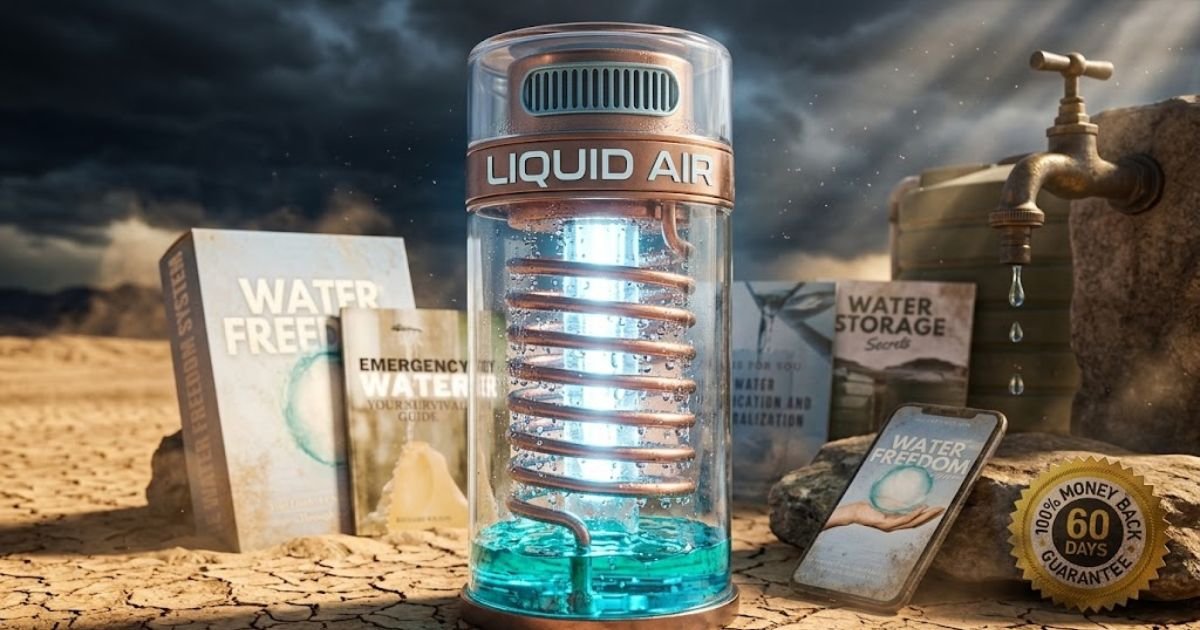
Imagine pulling clear, drinkable water directly out of thin air while your neighbors stare down dry faucets during a grid outage. That isn’t sci-fi lore—it’s basic thermodynamics, wrapped in a polarizing DIY guide that’s taken off-grid forums by storm.
The Water Freedom System promises to break your reliance on municipal supply lines, fragile infrastructure, and deep wells. But behind the aggressive marketing and dramatic survival sales pitches lies a very real, surprisingly accessible mechanical process: Atmospheric Water Generation (AWG). Instead of tapping into local aquifers or praying for rain, this design forces ambient water vapor to undergo a physical phase change, transforming invisible humidity into liquid water you can actually drink.
[ Ambient Air Intake ]
         │
         ▼
[ Condensation Chamber ] ──► (Phase Change: Vapor to Liquid)
         │
         ▼
[ Multi-Stage Filtration ] ──► (Particulate, VOC, & Microbial Removal)
         │
         ▼
[ Purified Water Storage ]
What Is the Water Freedom System? (Direct Definition & Core Concept)
The Short Answer: The Water Freedom System is a downloadable instructional manual detailing how to repurpose standard compressor coils, dehumidification components, and water filters into a localized atmospheric water generator (AWG).
[👉 Access the Official Water Freedom System Step-by-Step Blueprint Here]
While most people think of off-grid water as rain barrels catching roof runoff, this system operates on a totally different layer of physics. Rainwater collection is passive—you’re at the mercy of the weather. Atmospheric water generation is active. By pulling raw air across surfaces cooled below the local dew point, the machine forces water vapor to shed its kinetic energy and drop out of the gas phase, condensing into liquid droplets on demand.
                  ┌─────────────────────────────────────────┐
                  │          ATMOSPHERIC WATER              │
                  │          GENERATION (AWG)               │
                  └────────────────────┬────────────────────┘
                                       │
            ┌──────────────────────────┴──────────────────────────┐
            ▼                                                     ▼
┌───────────────────────┐                             ┌───────────────────────┐
│ Active Phase Change   │                             │ Passive Collection    │
│ (Refrigeration Loop)  │                             │ (Precipitation Runoff)│
└───────────┬───────────┘                             └───────────┬───────────┘
            │                                                     │
            ▼                                                     ▼
┌───────────────────────┐                             ┌───────────────────────┐
│ Water Freedom System  │                             │  Rainwater Harvesting │
└───────────────────────┘                             └───────────┬───────────┘
Atmospheric Water Generation (AWG): The Core Technology Explained
The heart of any AWG setup isn’t magic—it’s a vapor-compression refrigeration loop, governed by a straightforward equation:
At its core, Atmospheric Water Generation operates via a standard vapor-compression refrigeration loop, driving a phase change based on localized atmospheric vapor pressure and dew point dynamics:
$$\text{Relative Humidity (RH)} = \left( \frac{p_{H_2O}}{p^*_{H_2O}} \right) \times 100\%$$
Where:
- $p_{H_2O}$ is the partial pressure of water vapor currently sitting in your local air.
- $p^*_{H_2O}$ is the equilibrium vapor pressure over pure water at that exact same air temperature.
Here’s what happens in practice: powerful fans pull humid air over a set of chilled evaporator coils. As that warm air hits the cold metal, its temperature plunges past the dew point ($T_d$). Because colder air simply cannot hold as much moisture as warm air, the gaseous vapor gives up, turning into liquid beads that cling to the metal fins before pooling into a collection tray below.
Condensed Vapor vs. Rainwater Collection: Key Technical Differences
| Feature | Atmospheric Vapor Condensation (AWG) | Rainwater Collection |
| Primary Mechanism | Active thermodynamic phase change via refrigeration loop | Passive surface runoff diversion and gravity collection |
| Precipitation Dependency | Zero. Operates continuously if relative humidity $\ge 30\%$ | High. Entirely dependent on local rainfall volume |
| Initial Contaminant Profile | Low (mainly airborne particulates, VOCs, ambient dust) | High (roof debris, heavy metals, bird droppings, urban runoff) |
| Energy Input Required | High (electricity needed to run compressor and intake fans) | Zero to minimal (passive gravity flow or low-wattage sump pump) |
How the Water Freedom System Works: Step-by-Step Breakdown
If you look past the hype, operating a Water Freedom System setup to turn thick summer air into clean drinking water follows a strict path.
       [ Intake Fan ]
             │
             ▼
   [ Condenser / Evaporator ]  ◄── (Phase Change Zone)
             │
             ▼
   [ Collection Reservoir ]
             │
             ▼
 [ Sediment Filter (5 Micron) ]
             │
             ▼
 [ Activated Carbon Filter ]
             │
             ▼
[ Reverse Osmosis / UV Stage ]
             │
             ▼
   [ Potable Water Output ]
Condenser Coils and Air Draught Dynamics
- Air Induction: A high-CFM (cubic feet per minute) intake fan forces ambient air inside a sealed, dark condensation chamber.
- Thermal Drop: The incoming air slams into cold copper or aluminum coils loaded with circulating chemical refrigerant (like R-134a or R-600a).
- Condensation & Coalescence: The air hits its dew point instantly. Micro-droplets gather on the coil fins, link up, grow heavy, and drop straight down into a pan.
- Exhaust Discharge: Dry, cooled air gets blown back out into the room or back yard,leaving its moisture behind. This cooling cycle forms the core performance of the Water Freedom System build
Filtration Layers: Removing Particulate, Bacteria, and Volatiles
Raw condensation isn’t instantly pure water. It pulls whatever dust or pollen was floating in the air right down with it, and dark, damp coils are a breeding ground for mold if ignored. That’s why multi-stage filtration isn’t optional—it’s essential:
- Stage 1: Mechanical Sediment Filter (5-micron): Catches dust, floating dirt, and coarse airborne debris drawn in by the intake fan.
- Stage 2: Activated Carbon Block: Neutralizes chemicals, agricultural VOCs, bad odors, and strange lingering smells.
- Stage 3: Advanced Purification (RO or UV): Kills off microbial threats that thrive on moist refrigeration coils, ensuring the Water Freedom System outputs clean water..
Power Supply Requirements: Off-Grid Solar vs. Grid Interconnect
An atmospheric water generator is an energy pig. Running a compressor motor and pulling heavy fan draughts requires real power, forcing you to make a choice about how you feed the machine.
┌─────────────────────────────────────────────────────────────┐
│                   POWER SOURCE OPTIONS                      │
└──────────────────────────────┬──────────────────────────────┘
                               │
            ┌──────────────────┴──────────────────┐
            ▼                                     ▼
┌───────────────────────┐             ┌───────────────────────┐
│ Grid Interconnect     │             │ Off-Grid Solar Array  │
│ (Standard 120V AC)    │             │ (Battery + Inverter)  │
└───────────┬───────────┘             └───────────┬───────────┘
            │                                     │
            ▼                                     ▼
┌───────────────────────┐             ┌───────────────────────┐
│ Simple, continuous    │             │ High upfront cost;    │
│ grid reliance         │             │ requires surge sizing │
└───────────────────────┘             └───────────────────────┘
- Grid Interconnect (120V AC): Simple, cheap, and reliable—until the grid goes dark. Plug it into any standard wall outlet, but accept that if the power cuts out, your water stops flowing.
- Off-Grid Solar Setup: True independence takes investment. You’ll need a dedicated photovoltaic array, a robust LiFePO4 battery bank, and a heavy-duty pure sine wave inverter sized explicitly to survive the fierce surge current every time the compressor kicks on.
Cost, Build Complexity, and ROI Analysis
Building a rig yourself costs way less than buying a shiny commercial unit off the shelf. If you want to review the full parts list and assembly schematics, you can check the Water Freedom System official guide to see what fits your budget.
Off-the-Shelf AWG Units vs. DIY Water Freedom Blueprint Costs
| Category | Turn-Key Commercial AWG Unit | DIY Water Freedom Build |
| Average Initial Cost | $1,500 – $4,500+ | $250 – $600 (Parts dependent) |
| Build Time | None (Plug and play) | 8 to 16 hours active assembly |
| Enclosure & Build Quality | Injection-molded plastic or stainless steel | Repurposed dehumidifier casing or custom wood/metal frame |
| Warranty & Support | 1 to 3 Year Manufacturer Warranty | Self-maintained / DIY repair |
Daily Water Yield (Gallons/Day) by Relative Humidity and Climate Zone
How much water will you actually get? That all depends on where you live, what the temperature looks like, and how thick the air feels.
[ High Yield ] ────────────────── RH 70-90% / Temp 80-90°F (Subtropical)
[ Medium Yield ] ──────────────── RH 50-65% / Temp 70-80°F (Temperate)
[ Low/No Yield ] ──────────────── RH <30%   / Temp <60°F   (Arid/Cold)
Daily Yield Curve (Gallons / 24 Hours)
   ▲
 5 │                                             ●  (85°F, 80% RH)
 4 │                                     ●
 3 │                             ●
 2 │                     ●
 1 │             ●
 0 └─────────────┴───────┴───────┴───────┴───────┴────────► Relative Humidity (%)
   10%          30%     50%     60%     70%     80%
- Arid / Desert Climates (RH $<30\%$, Temp $>90^\circ\text{F}$):0.2 to 1.0 Gallons/Day. Dry desert air holds almost nothing. Your coils will freeze over long before you fill a pitcher.
- Temperate / Inland Climates (RH $50\%-65\%$, Temp $70^\circ\text{F}-80^\circ\text{F}$):2.0 to 4.5 Gallons/Day. Solid, dependable performance that can comfortably cover a family’s core drinking needs.
- Subtropical / Coastal Climates (RH $70\%-90\%$, Temp $80^\circ\text{F}-90^\circ\text{F}$):5.0 to 8.0+ Gallons/Day. Hot, soup-thick air drives peak efficiency, pouring water into your storage tanks around the clock.
- Ready to build your own off-grid water source? You can get instant access to the Water Freedom System digital blueprint and start gathering your parts today.
Real Questions People Ask Before Building
Will this thing actually produce water in a dry desert?
Honestly? Barely. When relative humidity dips under 30%, the math stops working in your favor. You’ll spend a fortune on electricity just to pull out a few warm ounces of condensation. If you live in Nevada or Arizona, look into deep wells or rain catchment instead.
Can I just drink the water straight out of the collection basin?
Please don’t. Raw condensation pulls down airborne dust, mold spores, and pollen, and dirty coils can leach trace contaminants into the liquid. Run it through proper sediment filters, carbon blocks, and a quick UV sterilizer before taking a sip.
How much is this going to jack up my electric bill?
A typical DIY rig draws anywhere from 300W to 600W continuously while the compressor is humming. To pull 3 to 5 gallons of water out of mid-range air, expect to burn roughly 4 to 8 kWh of electricity per day.
Products / Tools / Resources
- High-Efficiency Dehumidifiers: Sourcing a reliable unit with an accessible compressor coil setup serves as the primary mechanical engine for a DIY build.
- Inline Filtration Systems: Multi-stage setups featuring 5-micron sediment screens and dense activated carbon blocks are critical for removing particulates and volatiles.
- Ultraviolet (UV) Inline Sterilizers: A low-wattage UV-C chamber installed post-filtration neutralizes mold spores, bacteria, and microbial threats without using chemicals.
- Pure Sine Wave Inverters & Solar Generators: Essential off-grid power components designed to handle high compressor start-up surges without tripping protection circuits.
- Digital Hygrometers & Dew Point Meters: Inexpensive monitoring tools that allow you to track ambient relative humidity and optimize operating schedules for maximum yield.