There is a specific kind of silence that falls over a room when you realize you’ve been played.
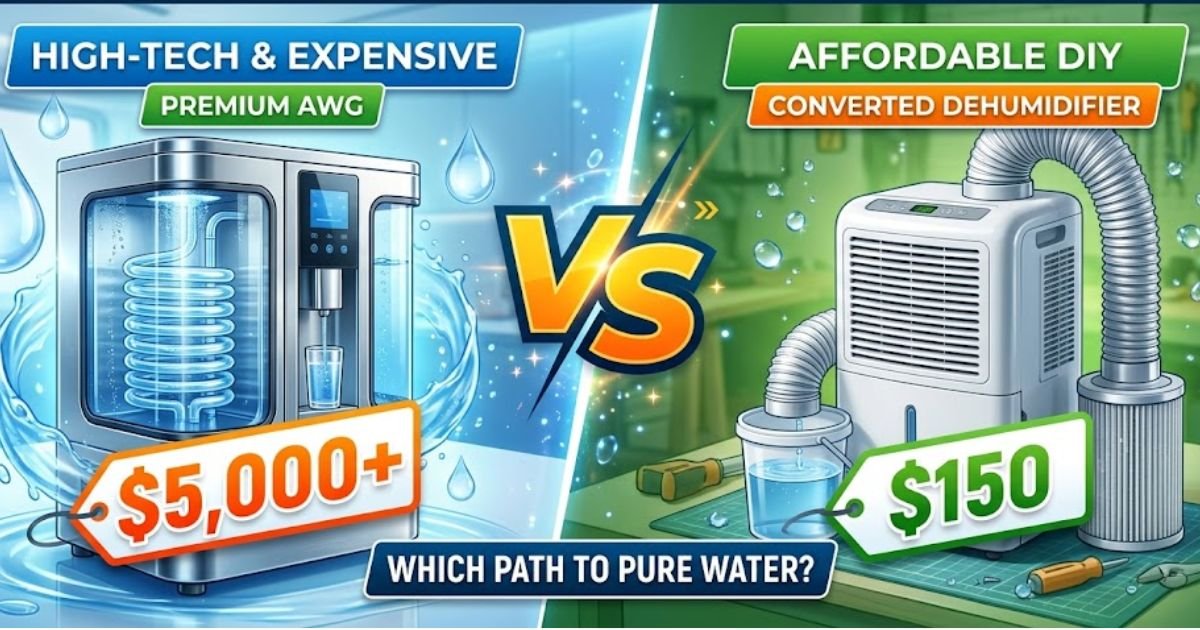
For years, the atmospheric water generation industry has sold a very expensive, very slick illusion. They’ve marched into survivalist expos and off-grid homesteading forums, dropping $5,000 to $10,000 price tags on sleek plastic boxes, promising total water sovereignty. But peel back the branded touchscreen and the marketing gloss, and you find a thermodynamic truth they’d rather you ignore.
The core mechanism—pulling liquid water out of thin air—isn’t a proprietary secret. It’s just basic physics. It’s a refrigeration cycle.
If you’re willing to get your hands dirty, you can bypass the corporate tax entirely. You can build a high-yield, food-grade atmospheric water harvester for the price of a weekend grocery run.
This is the “Frankenstein” AWG masterclass. We aren’t just assembling parts; we are engineering resource independence. By repurposing heavy-duty HVAC components and wiring in advanced micro-filtration, we’re going to build a cheap alternative to commercial atmospheric water generators that laughs in the face of five-figure price tags. This step-by-step guide shows you exactly how to build a cheap alternative to commercial atmospheric water generators that actually works.
Let’s tear down the premium trap and get to work.
The Economics of Atmospheric Water: Why You Need a Cheap Alternative to Commercial Atmospheric Water Generators
You can’t outsmart a system until you understand exactly how it’s rigged. Commercial AWGs are designed for profit margins first, thermodynamic efficiency second. By dissecting their pricing and operational quirks, we expose the exact vulnerabilities our DIY build will exploit.
Deconstructing the Thermoelectric Markup vs. Compressor Reality
Walk the floor at any prepper expo, and you’ll see two distinct camps of water generators: thermoelectric (Peltier) and compressor-based.
The slick booths usually push small, 1-to-3 gallon-per-day (GPD) thermoelectric units for upwards of $800. The markup is borderline insulting. They market the “solid-state” nature of Peltier modules as a premium feature, conveniently glossing over the fact that thermoelectric cooling is notoriously inefficient at scale. It drinks electricity and spits out a trickle of water.
Then there are the large compressor-based units. The ones that actually work. They sit behind velvet ropes, priced at $5,000 or more. Why? Because the manufacturers bundled a standard vapor-compression refrigeration cycle with a proprietary microcontroller, a branded UV light, and a molded plastic shell. Our DIY approach strips away the vanity. We’re going to use the highly efficient compressor method via repurposing, without paying the “survivalist tax.“The dehumidifier-to-AWG conversion remains the most viable cheap alternative to commercial atmospheric water generators for high-volume production.”
Calculating the True Cost-Per-Gallon (CPG) of Retail Atmospheric Generators
The sticker price is just the entry fee. The real bleed happens in the Cost-Per-Gallon (CPG). This is where you factor in electricity, proprietary filter replacements, and maintenance.
Let’s run the math on a mid-tier commercial AWG:
- Power Draw: 800 watts running 10 hours a day equals 8 kWh/day. At $0.15/kWh, you’re burning $1.20 a day in electricity.
- Yield: 5 gallons a day (assuming perfect, 80% humidity).
- Electricity CPG: $0.24 per gallon.
- Filter/Maintenance CPG: Add another $0.10 per gallon for their proprietary carbon and UV replacements.
- Total Commercial CPG: $0.34 per gallon.
Now, look at our $150 Frankenstein build. By utilizing a high-efficiency residential dehumidifier and open-source filtration, we drop the electricity CPG to roughly $0.08 and the maintenance CPG to $0.02. Total DIY CPG: $0.10 per gallon. You aren’t just saving money on the initial build. You are permanently slashing your operational overhead.
The Humidity Dependency Flaw in $5,000+ Commercial Units
Here is the ultimate Achilles heel of the commercial AWG industry: they lie about their yield.
A commercial unit might boldly print “10 Gallons Per Day” on the cardboard. But if you squint at the microscopic asterisk, that yield is calculated at 80% Relative Humidity (RH) and a sweltering 86°F (30°C). If you live in a moderate climate where the humidity drops to 40% at night, a commercial compressor unit will barely produce a thimble of water, all while still drawing full amperage.
Our Frankenstein architecture is adaptable. Because we are building the system from the ground up, we can swap out the condensation method based on our local microclimate. We can use high-volume compressor condensation for humid days, and pivot to passive or thermoelectric methods for low-humidity, high-solar environments.
The Dehumidifier-to-AWG Conversion: The Most Viable Cheap Alternative
If you need high-volume water—say, 3 to 10+ gallons a day—and you have access to grid power or a robust solar bank, the dehumidifier conversion is the undisputed king of cheap AWG alternatives. A dehumidifier is, fundamentally, just an atmospheric water generator that hasn’t been told it’s supposed to make drinking water.
Sourcing High-Capacity Residential Dehumidifiers (Under $150) for Base Condensation
Your first mission is sourcing the core engine. You want a 50-to-70-pint capacity dehumidifier. Hit the local thrift stores, scour Facebook Marketplace, or dig through the “open box” section of big-box hardware stores. You can routinely find these beasts for $50 to $120.
Critical Engineering Caveat: Standard dehumidifiers use aluminum coils coated in hydrophilic chemicals to shed water into a plastic drip pan. These factory coatings are not food-grade. They are toxic.
- The Fix: You must source a unit with bare copper coils. If you can’t find one, you have to carefully remove the factory drip pan and fabricate a custom, food-grade stainless steel or FDA-approved polyethylene catchment tray directly beneath the coils. You need to catch the condensate before it ever touches the factory plastic.
The Missing Link: Integrating Food-Grade UV-C and Activated Carbon Filtration
Condensate is essentially distilled water, but as it forms on the cold coils, it acts as an atmospheric scrubber. It pulls in Volatile Organic Compounds (VOCs), dust, and airborne pathogens. It is “gray water” until you treat it. When selecting your UV-C chamber, look for units that meet NSF water treatment certification standards to ensure the 254nm wavelength output is consistent and effective against pathogens like Giardia and Cryptosporidium
To transform your Frankenstein AWG into a potable water source, we bypass the factory reservoir and route the water directly through a closed-loop filtration manifold:
- Sediment Pre-Filter (5-micron): Catches physical dust and coil particulates.
- Activated Carbon Block (0.5-micron): This is non-negotiable. It adsorbs the VOCs, ozone byproducts, and chemical off-gassing pulled from the air.
- UV-C Disinfection Chamber (254nm wavelength): Water flows through a quartz-sleeved UV-C chamber. This shatters the DNA of bacteria, viruses, and cysts, ensuring biological safety without adding a chemical taste.
Condensate Pump Integration and Gravity-Fed Routing for Off-Grid Flow
Dehumidifiers rely on gravity to fill a small internal bucket. For a true AWG, we need active routing.
Install a 12V diaphragm pump or a small peristaltic pump in your custom catchment tray. Wire it to a float switch. When the water level hits the “on” mark, the pump pushes the water through the carbon and UV filters, and into a clean, sealed, food-grade storage bladder or glass carboy. Because the system is closed and pressurized post-pump, you completely eliminate the risk of post-treatment airborne contamination.
Peltier Effect DIY Builds: When to Use Thermoelectric Coolers (TECs)
Not everyone has the physical space for a dehumidifier, and not everyone has grid power. If you are building a micro-harvester for a bug-out bag, a small cabin, or a purely solar-driven off-grid setup, we pivot to the Peltier effect.
12V TEC Modules vs. Compressor Coils: Thermodynamic Efficiency Breakdown
Thermoelectric coolers (TECs) use the Peltier effect: when DC electricity passes through dissimilar semiconductors, one side gets freezing cold, and the other gets blisteringly hot.
While highly inefficient for whole-home water generation, TECs are brilliant for micro-climates. A compressor requires a massive, violent surge of AC power to start. A 12V TEC module draws a steady, predictable 60-120 watts. If your goal is to build a silent, solid-state harvester that produces 1 to 2 liters a day directly from a 100W solar panel, the TEC is your weapon of choice.
Heat Sink Optimization and Ambient Airflow Dynamics for Maximum Yield
The fatal flaw of DIY Peltier builds is poor thermal management. If the hot side of the TEC isn’t cooled perfectly, the cold side warms up, and condensation stops. It’s that simple.
To maximize yield, you must treat the hot side like a high-end gaming PC:
- The Cold Side: Attach a large, finned aluminum extrusion heat sink. This maximizes the surface area for atmospheric moisture to condense.
- The Hot Side: Attach an even larger heat sink, paired with a high-CFM 12V computer fan.
- The Interface: Use high-quality synthetic thermal paste between the TEC and both heat sinks. A 1mm gap of air will destroy your efficiency.
Angle the cold-side heat sink slightly downward so the condensed water drips directly into your collection trough.
Building a Solar-Powered Peltier Water Harvester for True Off-Grid Autonomy
To make this truly off-grid, power the TECs and fans directly from a 12V lithium iron phosphate (LiFePO4) battery bank, regulated by an MPPT charge controller.
Because TEC efficiency drops as ambient temperature rises, program your system to run primarily during the cooler night hours and early morning. This is when the dew point depression is lowest and the air holds less moisture, but the temperature differential between the cold coil and the air is most effective.
Potability, Safety, and Water Quality Standards for DIY AWGs
We have to address the most critical aspect of this build: human safety. Building a water generator is easy. Building a safe water generator requires rigorous, uncompromising discipline. Atmospheric condensate is not automatically drinking water.
Why Atmospheric Condensate is Not Automatically ‘Drinking Water’ (Biological vs. Chemical Risks)
When water condenses from the air, it doesn’t just pull H2O. It pulls the atmosphere’s chemical soup.
- Chemical Risks: If you use a repurposed AC coil, the aluminum fins and factory coatings can leach heavy metals and toxic surfactants into the water. Furthermore, the air in your home contains VOCs from cleaning supplies, off-gassing furniture, and outdoor pollution.
- Biological Risks: The dark, damp environment of a condensation tray is a breeding ground for mold, mildew, and airborne bacteria (like Legionella). If the water sits stagnant at room temperature, biofilm will form in hours.
Testing and Mitigating VOCs, Heavy Metals, and Ambient Pathogens
To mitigate these risks, your Frankenstein AWG must include a robust post-treatment protocol.
- Bypass the Coils: As mentioned, use a food-grade catchment tray to prevent metal leaching.
- Aggressive Carbon Filtration: Use a high-capacity activated carbon block (not just granular carbon) to ensure sufficient “contact time” to adsorb VOCs.
- Final Polish: For absolute certainty, run the water through a small countertop Reverse Osmosis (RO) membrane after the UV stage. This will strip any remaining dissolved solids, ensuring the water is chemically pristine.
- Test Regularly: Use a comprehensive home water testing kit to check for coliform bacteria, lead, copper, and VOCs every 90 days. Don’t guess with your kidneys.
Establishing a Maintenance and Descaling Protocol for Long-Term System Health
A poorly maintained AWG becomes a biological hazard. Establish a strict maintenance loop:
- Weekly: Flush the UV-C chamber and check the quartz sleeve for cloudiness. Wipe it down with white vinegar.
- Monthly: Run a food-grade citric acid solution through the condensation routing to descale any mineral buildup from the air. Replace the 5-micron sediment filter.
- Annually: Replace the carbon block, the UV-C bulb (UV intensity degrades over 12 months even if the light still turns on), and sanitize the entire cold-side catchment area with a mild hydrogen peroxide solution.
Can I actually drink this stuff straight from the drip tray?
No. Water condensed from a standard dehumidifier is considered gray water due to potential chemical leaching from factory coils and airborne biological contaminants. It must be routed through a food-grade catchment system, a 0.5-micron carbon block filter, and a 254nm UV-C disinfection chamber before it is safe for human consumption.
How much water am I really going to pull out of the air?
A repurposed 50-to-70-pint residential dehumidifier, optimized with a custom food-grade catchment tray, can produce between 3 to 7 gallons of water per day. But that number is entirely dependent on the ambient temperature and relative humidity (RH) of your environment.
Should I just buy a Peltier kit instead of hacking a dehumidifier?
They serve completely different purposes. Compressor-based dehumidifier conversions are vastly superior for high-volume (3+ gallons/day) water generation. Peltier (TEC) builds are highly inefficient at scale, but they are ideal for micro-harvesting (1-2 liters/day) in 100% off-grid, solar-powered, or portable applications due to their low 12V DC power draw.
What’s the fastest way to ruin this build?
Ignoring the hot-side thermal management on Peltier builds, or failing to bypass the toxic, non-food-grade drip pans and hydrophilic coil coatings on repurposed commercial dehumidifiers.
Products / Tools / Resources
12V Diaphragm Pump with Float Switch
You need active routing to move water out of the catchment tray and into your filtration manifold. Look for a self-priming 12V pump rated for at least 2 GPM. Pair it with a simple mechanical float switch to automate the transfer process and prevent dry running.
254nm UV-C Disinfection Chamber
This is your biological fail-safe. Ensure you are buying a chamber specifically rated for 254nm wavelength, which is the exact frequency required to disrupt pathogen DNA. Check the flow-rate rating to ensure the water isn’t moving through the quartz sleeve too quickly to be properly sanitized.
0.5-Micron Activated Carbon Block Filter
Granular carbon is fine for a pitcher, but for an AWG, you need a solid carbon block. The 0.5-micron rating ensures you are physically trapping cysts while the dense carbon matrix adsorbs the VOCs and chemical off-gassing pulled from the ambient air.
TEC1-12706 Peltier Modules
If you are going the thermoelectric route, these are the industry standard 12V modules. They are cheap, widely available, and capable of creating a massive temperature differential when properly powered. Buy a few extras; they are fragile and easy to crack during installation.
High-CFM 12V Computer Fans & Aluminum Extrusion Heat Sinks
Thermal management is everything. You need massive surface area on the cold side to catch the water, and aggressive airflow on the hot side to exhaust the heat. Don’t skimp on the thermal paste between the Peltier tile and the heat sinks.
Food-Grade Polyethylene Sheeting
If your scavenged dehumidifier has a toxic factory drip pan, you’ll need to line or replace it. FDA-approved, food-grade polyethylene is cheap, easy to cut with a utility knife, and completely inert, ensuring your condensate never touches industrial chemicals.