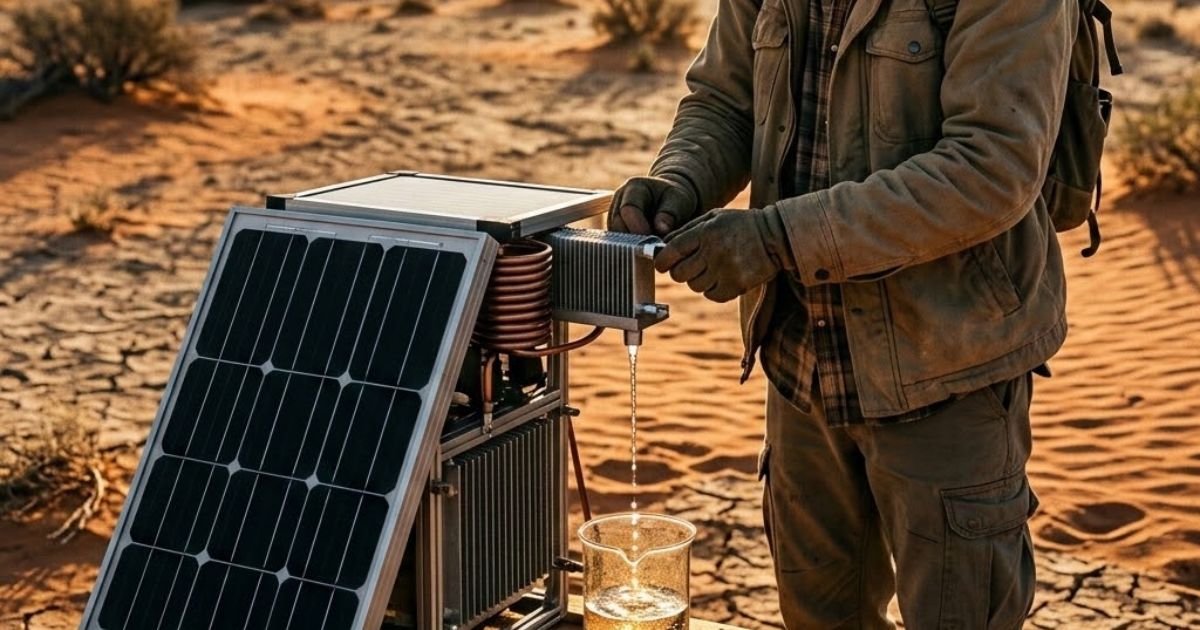
Learning how to extract drinking water from air moisture is an essential off-grid survival skill when municipal water supplies fail. An estimated 12,900 cubic kilometers of fresh water are floating right above your head at this exact moment. It sits trapped in the air—an invisible ocean larger than every river on Earth combined, drifting over scorching deserts, suburban roofs, and drying lakebeds alike.
Yet most people walk right beneath it, completely unaware, while worrying about municipal water cuts, drought warnings, or dry well pumps.
Learning how to pull clean drinking water straight from atmospheric moisture isn’t some futuristic sci-fi pipe dream. It’s an essential off-grid survival skill—and the ultimate insurance policy when the grid goes dark or the tap runs dry. Official Website
       [ Ambient Air Input ]
                 │
                 ▼
      ┌─────────────────────┐
      │ Thermal Cooling or  │ ──► Drops air temperature below Dew Point
      │ Desiccant Materials │
      └─────────────────────┘
                 │
                 ▼
      [ Condensate Liquid ]
                 │
                 ▼
   ┌───────────────────────────┐
   │ Multi-Stage Filtration    │ ──► HEPA + Activated Carbon + UV-C Disinfection
   └───────────────────────────┘
                 │
                 ▼
   ┌───────────────────────────┐
   │  Re-Mineralization Cell   │ ──► Restores Calcium & Magnesium for Potability
   └───────────────────────────┘
                 │
                 ▼
       [ Safe Drinking Water ]
The Science of How to Extract Drinking Water From Air Moisture
Dew Point Optimization: How Temperature and Relative Humidity Yield Liquid Water
At its core, pulling water from thin air is an exercise in phase-change thermodynamics: forcing vapor to turn into liquid. The magic number you need to pay attention to is the dew point—the precise temperature where air becomes completely saturated ($100\%$ relative humidity) and can no longer hold onto its moisture.
   Relative Humidity vs. Extraction Efficiency

   100% ┤                                    ████████ (Maximum Yield)
    80% ┤                           ████████████████
    60% ┤                  █████████████████████████
    40% ┤         ██████████████████████████████████ (High Energy Cost)
    20% ┤  █████████████████████████████████████████ (Minimal Extraction)
         └───────┬────────┬────────┬────────┬───────
                10°C     20°C     30°C     40°C
                         Ambient Temperature
When air cools down to its dew point, water molecules lose energy, slow down, and cluster together on any surface nearby. Your total water harvest depends almost entirely on two moving targets:
- Relative Humidity (RH): This tells you how much water vapor is hanging out in the air compared to the absolute maximum it could hold at its current temperature. If your local humidity plummets below $30\%$, pulling liquid water out of the air becomes significantly harder.
- Ambient Air Temperature: Warm air is greedy—it holds exponentially more moisture than cold air. Air sitting at $30^\circ\text{C}$ ($86^\circ\text{F}$) holds nearly double the water vapor of air at $20^\circ\text{C}$ ($68^\circ\text{F}$) at the exact same humidity percentage.
If you want to know what kind of yield you’ll get, pull up a psychrometric chart. If the ambient air around your shelter sits at $25^\circ\text{C}$ ($77^\circ\text{F}$) with $60\%$ relative humidity, you only need to cool a metal surface down to $16.7^\circ\text{C}$ ($62^\circ\text{F}$) to watch clear water start droplets forming and dripping down.
Condensation vs. Desiccant Absorption: Choosing the Right Extraction Mechanism
To get that water into a cup, you have two very different engineering routes to choose from: Refrigerant Condensation or Desiccant Absorption.
| Feature | Refrigerant Condensation Systems | Solid/Liquid Desiccant Systems |
| Primary Mechanism | Active mechanical cooling below the dew point | Hygroscopic absorption followed by thermal release |
| Minimum Humidity Threshold | $35\%$ to $40\%$ Relative Humidity | $10\%$ to $15\%$ Relative Humidity |
| Energy Profile | High electrical draw (compressor-driven) | Low electrical draw; high thermal/solar energy need |
| Operational Sweet Spot | Warm, humid coastal or tropical climates | Arid, desert, or cold low-humidity environments |
| Maintenance Complexity | Moderate (coils, refrigerant lines, fans) | High (desiccant cycling, thermal heat exchangers) |
Refrigerant Condensation works just like the air conditioner sitting in your window or a garage dehumidifier. A compressor pumps refrigerant through a closed loop, turning an evaporator coil freezing cold. Warm air gets blown over the coil, hits that sudden temperature drop, and immediately sheds its water weight. It works wonders in humid, muggy climates—but the moment you take it out into an arid desert where the dew point sits near freezing, efficiency collapses.
Desiccant Extraction, on the other hand, relies on water-thirsty materials like silica gel, lithium chloride, or synthetic zeolites. These materials sponge up moisture straight out of bone-dry air, even when humidity dips down to a brutal $15\%$. Once the material is soaked through, you use a heat source—like a concentrated solar collector—to bake the desiccant inside a sealed box. The trapped water bakes out as concentrated steam, hits a cooling plate, and drops into your jug. If you’re building for desert survival, desiccants are non-negotiable.
DIY Methods: Extracting Potable Water with Everyday Materials
When civil infrastructure breaks down, waiting on relief supplies isn’t an option. You can assemble working water harvesters using basic survival kit gear or repurposed scrap hardware.
       [ Solar Traps ]                   [ Thermoelectric ]                 [ Re-Engineered Tech ]
              │                                  │                                    │
              ▼                                  ▼                                    ▼
┌──────────────────────────┐       ┌──────────────────────────┐         ┌──────────────────────────┐
│ Solar Still /            │       │ Peltier Cooling          │         │ Sealed Dehumidifier      │
│ Transpiration Trap       │       │ Plate Array              │         │ Modification             │
├──────────────────────────┤       ├──────────────────────────┤         ├──────────────────────────┤
│ Yield: 0.5 - 2.0 L/day   │       │ Yield: 1.0 - 4.0 L/day   │         │ Yield: 10.0 - 20.0 L/day │
│ Energy: Passive Solar    │       │ Energy: 12V DC Off-Grid  │         │ Energy: 300W-600W AC     │
└──────────────────────────┘       └──────────────────────────┘         └──────────────────────────┘
Method 1: The Solar Still & Transpiration Trap System (Survival Baseline)
A transpiration trap uses raw solar heat to force ground moisture and plant sap up into a closed environment where you can capture it.
1.Location Selection:Maximize direct thermal exposure.
Find a spot that bakes in full sun all day—preferably south-facing ground packed with damp soil or lush, leafy vegetation. Dig a pit roughly 3 feet wide and 2 feet deep.
2.Reservoir Placement:
Set a clean container right in the center of your pit. Pack green foliage around the base—freshly cut leaves, grass, or non-toxic wild plants work great to boost moisture output.
3.Sealing the Chamber:
Stretch a sheet of clear plastic over the opening. Seal every inch of the outer perimeter with dirt, rocks, and mud so no moist air can escape.
4.Angle the Condensation Path:
Drop a small pebble right into the middle of the plastic directly over your collection cup. This creates a $45^\circ$ cone, so as water condenses on the underside, it runs down to the tip and drips right into your container.
Method 2: The Peltier Effect Water Harvester (Thermoelectric Cooling)
If you’re running a small $12\text{V}$ solar power system, you can build a solid-state water generator using Peltier cooling plates—no noisy compressors or hazardous gases required.
                  [ 12V DC Power Source ]
                             │
                             ▼
  ┌─────────────────────────────────────────────────────┐
  │                 CPU Heat Sink & Fan                 │ (Heat Dissipation Zone)
  └─────────────────────────────────────────────────────┘
  =================== [ Peltier Plate ] ===================
  ┌─────────────────────────────────────────────────────┐
  │              Cold Aluminum Heatsink                 │ (Condensation Zone)
  └─────────────────────────────────────────────────────┘
                             │
                             ▼
                  [ Condensate Drip Tray ]
- Assembly: Sandwich a $12\text{V}$ TEC1-1206 Peltier chip between two aluminum CPU heat sinks using a thin layer of thermal paste.
- Heat Dissipation Side: Mount a high-speed $12\text{V}$ cooling fan directly onto the hot side. You need to dump heat fast; the colder you keep the hot side, the icier the cold side gets.
- Condensation Side: Enclose the cold heat sink inside an insulated, food-safe plastic housing or duct. Use a low-speed fan to draw outside air slowly across those icy aluminum fins.
- Collection: As the warm air rolls across the cold metal, moisture snaps into liquid drops, trickles down the fins, and drains straight down a collection tube.
Method 3: Dehumidifier Re-Engineering (Repurposing Household Tech Safely)
A standard home dehumidifier is essentially a high-capacity water harvester waiting to be unlocked. But here’s the catch: off-the-shelf dehumidifiers were never designed for drinking water. Their coils are often coated in chemical anti-corrosives, soldered with trace metals, and their plastic catch basins grow bacteria overnight.
- Coil Coating: Coat those copper coils with food-grade epoxy or build a custom stainless-steel shroud around the cooling loops so raw condensate never touches bare, reactive metal.
- Hose Conversion: Rip out the cheap factory plastic hoses and swap them for food-grade silicone or NSF-61 certified tubing.
- Inline Filtration Insertion: Wire a small $12\text{V}$ high-pressure diaphragm pump right into the collection pan to push water through proper filters before it touches your drinking jar.
Purification and Filtration: Making Atmospheric Condensate Safe to Drink
Don’t let clear liquid fool you—water harvested from the air is essentially raw distilled water that has swept through the dirty atmosphere on its way down. Drinking it straight without treatment is a gamble you don’t want to take.
 Raw Airborne Condensate
   │
   ▼
[ Stage 1: 5-Micron Sediment Filter ] ──► Removes dust, pollen, suspended particulates
   │
   ▼
[ Stage 2: Activated Carbon Block ]   ──► Absorbs VOCs, heavy metals, chemical vapors
   │
   ▼
[ Stage 3: UV-C LED Sterilization ]   ──► Neutralizes bacteria, viruses, fungal spores
   │
   ▼
[ Stage 4: Re-Mineralization Cartridge ] ──► Infuses Ca2+, Mg2+ & balances pH to 7.5-8.5
   │
   ▼
 Pure Potable Water
Eliminating Airborne Pathogens, Volatile Organic Compounds (VOCs), and Heavy Metals
Smoke, vehicle exhaust, toxic dust, mold spores, and airborne pesticides all end up trapped in moisture droplets as they form. To make that water safe, line up a strict filtration sequence:
- Sediment Filtration (Pre-Filter): Run raw condensate through a 5-micron sediment filter first. This catches physical grit, floating pollen, and soot before it can clog your finer filters.
- Activated Carbon Block: Force the water through a dense activated carbon block. Carbon acts like a sponge for chemicals, locking away volatile organic compounds (VOCs), harsh solvents, fuel vapors, and weird smells.
- Biological Sterilization: Finish the job with an inline $254\text{nm}$ UV-C LED chamber. This blasts the DNA of bacteria, viruses, and parasites, rendering them completely harmless as water flows past at a minimum dose of $40\text{ mJ/cm}^2$.
Re-Mineralization Protocol: Restoring Calcium and Magnesium for Safe Consumption
Pure condensate is naturally hungry. Because it lacks minerals, it pulls carbon dioxide out of the surrounding air, making it acidic (typically dropping its pH down between 5.5 and 6.2). Drinking flat, mineral-stripped water over long periods can leach minerals right out of your teeth and body.
       [ Acidic Condensate Input: pH 5.5 - 6.2 ]
                          │
                          ▼
 ┌──────────────────────────────────────────────────┐
 │       Re-Mineralization Media Chamber            │
 ├──────────────────────────────────────────────────┤
 │  • Calcium Carbonate (Calcite)                  │
 │  • Magnesium Oxide (Corosex)                     │
 └──────────────────────────────────────────────────┘
                          │
                          ▼
       [ Mineralized Output: pH 7.5 - 8.5 ]
       [ TDS Target: 100 - 200 PPM          ]
To bring your water back to life:
- Run filtered water through a canister packed with Calcite (Calcium Carbonate) and Corosex (Magnesium Oxide).
- Target pH: Raise that flat, acidic condensate up to a crisp, refreshing pH 7.5 to 8.5.
- Target TDS: Aim for total dissolved solids (TDS) between 100 PPM and 200 PPM. This gives you great-tasting, thirst-quenching water that actually hydrates your cells.
Commercial AWG Units vs. DIY Setups: Efficiency, Output, and Energy Cost
Before sinking time or money into a build, you need to match your daily water requirements against the electrical juice you have available off the grid.
| Parameter | DIY Peltier Setup | Re-Engineered Dehumidifier | Commercial Off-Grid AWG Unit |
| Daily Output (at 60% RH, 25°C) | 1 – 4 Liters | 10 – 25 Liters | 20 – 500+ Liters |
| Average Energy Draw | 60W – 120W DC | 300W – 600W AC | 400W – 1200W AC/DC |
| Energy Efficiency Index | ~0.8 kWh / Liter | ~0.35 kWh / Liter | ~0.22 – 0.28 kWh / Liter |
| Est. Initial Hardware Cost | $50 – $150 | $200 – $450 | $1,500 – $8,000+ |
| Potability Readiness | Manual Filtration Needed | Custom Modifications Needed | Plug-and-Play (Built-in UV/Carbon) |
Daily Yield Benchmarks (Liters per kWh at 30%–80% Relative Humidity)
Your daily yield will swing wildly depending on where you set up camp:
- High-Humidity Zone ($70\% – 90\%$ RH): Top-tier commercial units pull an impressive 4.5 Liters per kWh.
- Moderate-Humidity Zone ($45\% – 65\%$ RH): Output settles into a steady 1.8 to 2.5 Liters per kWh.
- Arid/Desert Zone ($20\% – 35\%$ RH): Standard refrigeration units crash below $0.5\text{ Liters per kWh}$, while specialized desiccant setups hold firm around 1.2 Liters per kWh.
Best Off-Grid Power Solutions for AWG Systems (Solar & Battery Sizing)
Running a continuous Atmospheric Water Generator requires a correctly sized solar array and battery bank capable of handling motor starting surges.
                  [ Solar Array: 1,200W - 1,600W ]
                                 │
                                 ▼
                  [ MPPT Charge Controller ]
                                 │
                                 ▼
                  [ 48V LiFePO4 Battery: 5.12 kWh ]
                                 │
                                 ▼
                  [ Pure Sine Wave Inverter: 3,000W ]
                                 │
                                 ▼
                  [ AWG Unit + Inline Filtration ]
Sizing Example: Running a 400W AWG Unit for 10 Hours Daily (Target Output: ~15 Liters)
- Daily Energy Needs:$400\text{W} \times 10\text{ hours} = 4,000\text{ Watt-hours } (4\text{ kWh})$.
- Battery Bank Sizing: A $48\text{V}$, $100\text{Ah}$ Lithium Iron Phosphate ($\text{LiFePO}_4$) battery provides $5,120\text{ Watt-hours}$, offering a safe buffer above the $4\text{ kWh}$ daily requirement.
- Solar Panel Array Sizing: Assuming an average of 5 peak sun hours per day, account for a $20\%$ system loss efficiency factor:
$$\text{Required Array Size} = \frac{4000\text{ Wh}}{5\text{ hours} \times 0.80} = 1,000\text{ Watts}$$ - Recommendation: Install at least 1,200W of solar panels to cover cloudy days and system overhead.
- If you want an easy, DIY way to power your atmospheric water generator without spending thousands on commercial solar setups, check out the Energy Revolution System. It provides a simple, step-by-step blueprint to build a low-cost power source capable of running off-grid appliances and water systems smoothly.
Frequently Asked Questions
Is it actually safe to drink water straight out of an air harvester?
No, and you shouldn’t try it. Air is full of invisible debris—dust, pollen, exhaust fumes, toxic chemicals, and mold spores. When water condenses out of the air, it drags those particles right down with it. You always need to run raw condensate through a sediment filter, carbon block, and UV light before taking a sip.
Can these systems produce water in a dry desert environment?
Standard refrigeration-style units will struggle or freeze up once humidity drops below $30\%$. If you live in an arid region, you need a desiccant-based system. Desiccants use water-absorbing gels or salts that pull moisture out of air even down at $10\%$ to $15\%$ relative humidity, using solar heat to release it later.
How much power does it take to make a single gallon of water?
Under comfortable conditions ($60\%$ relative humidity at $25^\circ\text{C}$ / $77^\circ\text{F}$), a solid commercial system uses about 1.0 to 1.5 kWh per gallon (roughly 0.25 to 0.4 kWh per liter).
Can I just hook up a garden hose to my home dehumidifier and call it a day?
Only if you make some critical modifications first. Most household dehumidifiers use copper coils soldered with metals that leach into water, paired with cheap plastics that breed bacteria. To make it safe, you need to coat or replace the coils, install food-safe silicone lines, and pipe the output through an active carbon and UV filtration setup.
Recommended Products, Tools & Resources
- 12V DC Peltier Thermoelectric Cooler Modules (TEC1-1206): Solid-state cooling plates ideal for custom low-power, DIY water generator builds.
- High-CFM 12V Brushless Cooling Fans: Essential for rapid heat dissipation on Peltier heat sinks and pushing ambient air across cooling coils.
- Energy Revolution System (DIY Off-Grid Power Blueprint): A step-by-step guide for preppers and off-grid builders to generate reliable, low-cost electricity for powering DIY AWG units, pumps, and emergency equipment.
- Food-Grade Epoxy Coil Coating: A non-toxic, sealant spray designed to coat raw copper condensation coils, preventing heavy metal leaching into drinking water.
- Inline 12V DC Diaphragm Water Pump: Self-priming, low-power water pump used to drive raw condensate through multi-stage filtration arrays.
- NSF-61 Certified Silicone Tubing: Flexible, non-gassing, food-safe tubing designed to transport drinking water without contaminating taste or adding toxic phthalates.
- 5-Micron Melt-Blown Polypropylene Sediment Filter Cartridges: High-efficiency pre-filters designed to catch floating dust, pollen, and suspended dirt particulates.
- Solid Activated Carbon Block Filter Shells: Dense carbon filters that strip VOCs, chemical fumes, pesticides, and foul tastes out of harvested condensate.
- Inline 254nm UV-C LED Water Disinfection Chambers: Low-power, instant-on ultraviolet purifiers engineered to destroy bacterial and viral DNA in liquid streams.
- Remineralization Filter Cartridges (Calcite & Corosex Blend): Media cartridges designed to reintroduce calcium and magnesium into distilled condensate, raising pH to an alkaline-balanced $7.5 – 8.5$.
- 48V 100Ah LiFePO4 Lithium Battery Bank: Deep-cycle, long-lifespan lithium power storage ideal for running off-grid compressors and AWG systems overnight.
- Monocrystalline 400W Rigid Solar Panels: High-efficiency solar panels required to harvest sufficient watt-hours for continuous off-grid atmospheric water generation.
- Portable Digital TDS & pH Water Quality Meter: Essential testing tools to measure dissolved mineral counts (PPM) and balance water acidity before consumption.