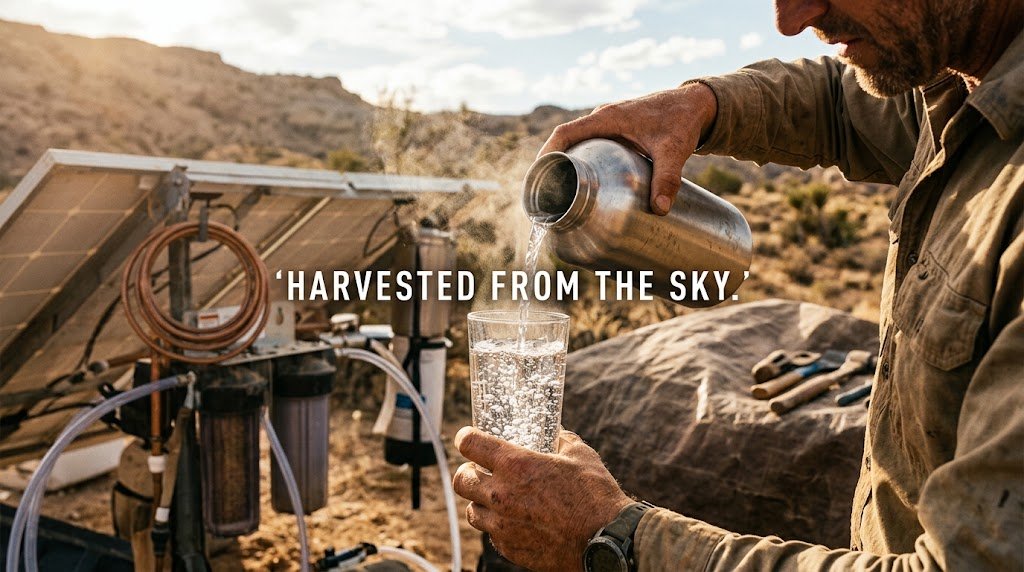
Every cubic meter of Earth’s atmosphere holds a hidden reservoir. On average, the air around us contains over 12,900 cubic kilometers of water vapor at any given moment—an invisible, renewable river flowing right past your front porch. While municipal infrastructure relies on aging pipes and subterranean aquifers subject to drought, atmospheric moisture remains largely immune to localized supply collapses.
Building a DIY atmospheric water generator (AWG) allows you to tap directly into this atmospheric hydrologic cycle. By manipulating temperature differentials, dew point thresholds, and phase transitions, a custom-engineered AWG pulls moisture straight out of ambient air, condenses it, and purifies it into clean drinking water.
This comprehensive technical guide provides a complete blueprint for constructing an off-grid, low-power atmospheric water generator capable of producing 5 gallons (approx. 19 liters) of potable water every 24 hours.
What Is a DIY Atmospheric Water Generator and How Does It Work?
An Atmospheric Water Generator (AWG) is a device that extracts ambient humidity and converts it into liquid water through condensation or desiccant-based adsorption. While industrial AWGs require massive electrical loads, an off-grid system leverages targeted thermodynamic principles to maximize water yield per watt of input energy.
The Thermodynamics of Dew Point and Relative Humidity
Water extraction efficiency hinges entirely on the relationship between three variables:
- Relative Humidity (RH): The percentage of water vapor present in the air relative to the maximum amount the air can hold at its current temperature.
- Ambient Temperature: The measure of thermal energy in the surrounding airmass. Warmer air holds exponentially more moisture (governed by the Clausius-Clapeyron relation).
- Dew Point: The precise temperature to which air must be cooled for water vapor to condense into liquid water ($H_2O$).
When an AWG drops the surface temperature of its internal cooling coil below the ambient air’s dew point, phase transition occurs. Moisture transitions from vapor to liquid droplets along the heat exchanger surface.
+------------------+      +-------------------+      +----------------------+
|  Ambient Air In  | ---> |  Cooling Matrix   | ---> | Liquid Condensation  |
| (High RH % / T°) |      | (Below Dew Point) |      | (Drips to Reservoir) |
+------------------+      +-------------------+      +----------------------+
Active Refrigeration vs. Passive Desiccant Systems
Off-grid AWG designs generally fall into two primary mechanical categories:
| Feature | Active Vapor-Compression (Refrigeration) | Passive/Hybrid Desiccant Systems |
| Primary Mechanism | Mechanical compressor circulates refrigerant to chill evaporator coils. | Solid/liquid desiccants (e.g., Silica Gel, $CaCl_2$) absorb moisture, then release it via solar heat. |
| Optimal Ambient RH | Best in Moderate-to-High RH environments ($>40\%$). | Functions effectively in Low RH environments ($<30\%$). |
| Energy Consumption | Moderate to High ($300\text{W} – 600\text{W}$ continuous draw). | Low electrical draw; requires thermal solar input for desiccant regeneration. |
| Daily Water Yield | High, consistent volume output when powered. | Low to Moderate volume; cycle-dependent. |
For a target yield of 5 gallons per day, an active vapor-compression system powered by a dedicated solar photovoltaic (PV) array remains the most reliable and space-efficient choice for off-grid applications.
Complete Bill of Materials (BOM) and Off-Grid System Specs
Building a high-yield, food-safe AWG requires selecting materials that prevent toxic leaching while maintaining high thermal conductivity and low energy draw.
                    [ 12V / 24V Solar PV Array ]
                                 |
                                 v
                     [ MPPT Charge Controller ]
                                 |
                                 v
                      [ LiFePO4 Battery Bank ]
                                 |
        +------------------------+------------------------+
        |                                                 |
        v                                                 v
[ Pure Sine Wave Inverter ]                     [ DC Buck Converter ]
        |                                                 |
        v                                                 v
[ Vapor-Compression Unit ]                      [ Low-Wattage UV-C & ]
[ & Axial Intake Fan     ]                      [ Transfer Pump Loop ]
Core Components & Specifications
- Cooling Engine (Vapor-Compression Core):
- 1x High-efficiency, low-power compressor unit or modified 50-pint rated dehumidifier core ($115\text{V}$, drawing roughly $280\text{W} – 350\text{W}$ under continuous operation). Ensure internal coils use hydrophobic, food-grade/epoxy-coated aluminum or copper with food-safe protective barriers to prevent heavy metal oxidation into the condensate.
- Air Circulation Dynamics:
- 1x Brushless $12\text{V}$ DC High-CFM IP67 Waterproof Axial Fan ($120\text{mm} – 140\text{mm}$, minimum $110\text{ CFM}$).
- 1x MERV 13 Washable Electrostatic Air Pre-Filter (captures dust, pollen, and airborne particulates before air hits the coils).
- Off-Grid Power Infrastructure:
- Solar Panel Array:$600\text{W} – 800\text{W}$ Monocrystalline PV Array.
- Charge Controller:$40\text{A}$ MPPT (Maximum Power Point Tracking) Charge Controller.
- Battery Storage:$200\text{Ah} – 300\text{Ah}$$12\text{V}$ ($2.56\text{kWh} – 3.84\text{kWh}$) $LiFePO_4$ (Lithium Iron Phosphate) battery pack.
- Inverter:$1000\text{W}$ Pure Sine Wave Inverter ($12\text{V}$ DC to $110\text{V}/220\text{V}$ AC).
- Water Collection & Multi-Stage Filtration Loop:
- Food-Grade Collection Funnel: BPA-free High-Density Polyethylene (HDPE) or 316 Stainless Steel tray.
- Water Pump:$12\text{V}$ DC Food-Grade Diaphragm Transfer Pump ($1.1\text{ GPM}$, auto-pressure shutoff).
- Filter Housing 1: 5-Micron Polypropylene Sediment Filter (removes suspended particles).
- Filter Housing 2: Activated Carbon Block Filter (removes VOCs, odors, and chemical trace elements).
- Filter Housing 3: Inline Mineralization Cartridge (adds essential calcium, magnesium, and potassium ions to balance pH).
- Sterilization:$12\text{V}$ Inline UV-C LED Water Disinfection Module ($254\text{nm}$ wavelength).
- Storage Tank: 7-Gallon BPA-Free Food-Grade Reservoir with automatic float switches.
Step-by-Step Construction Guide
Follow these mechanical, electrical, and plumbing assembly procedures to construct your off-grid AWG.
Phase 1: Engineering the Condensation Chamber & Air Flow Path
  [ Fresh Air ] ---> [ MERV 13 Filter ] ---> [ Cooling Coils ] ---> [ Dry Air Exhaust ]
                                                    |
                                             (Condensation)
                                                    v
                                          [ Stainless Collection Tray ]
- Enclosure Fabrication: Construct an insulated outer enclosure using $3/4\text{-inch}$ marine-grade plywood or a weather-proof $NEMA\text{-4X}$ polyethylene utility crate. Line the interior walls with $1\text{-inch}$ closed-cell foil-faced insulation board.
- Air Duct Channeling: Cut a $120\text{mm}$ air intake port at the bottom left of the enclosure and an exhaust port at the top right. This creates a diagonal cross-draft that maximizes contact time across the cooling surfaces.
- Pre-Filter Housing: Mount the MERV 13 filter frame directly over the air intake port. Seal edges with food-grade silicone to ensure no un-filtered air bypasses the intake.
- Cooling Core Mounting: Position the compressor evaporator coils at a $45\text{-degree}$ incline within the chamber. Inclining the coils uses gravity to quickly pull water droplets down into the collection funnel, preventing droplets from re-evaporating into the exhaust stream.
- 👉 [Download the Complete Water Freedom System Blueprints Here]
Phase 2: Electrical Integration & Power Optimization
- Solar Subsystem Setup: Wire your solar panels in series/parallel to match your MPPT controller’s optimal voltage input range. Connect the MPPT controller directly to the $LiFePO_4$ battery bank using $4\text{ AWG}$ copper welding cable paired with a $100\text{A}$ inline breaker switch.
- Inverter Connection: Connect the $1000\text{W}$ Pure Sine Wave Inverter to the battery bank.
- Cooling System Wiring: Plug the compressor cooling core into the inverter output.
- DC Auxiliary Circuit: Run a fused $12\text{V}$ DC bus box directly from the battery bank to power the intake axial fan, $12\text{V}$ water transfer pump, and the inline UV-C LED module. This avoids unnecessary AC inverter conversion losses for low-voltage components.
Phase 3: Plumbing & Multi-Stage Filtration Loop
[ Collection Tray ] ---> [ Sediment Filter ] ---> [ Carbon Block ] ---> [ UV-C Module ] ---> [ Mineralization ] ---> [ Storage Tank ]
- Condensate Capture: Position the food-grade 316 Stainless Steel catch pan under the inclined evaporator coils. Install a $1/2\text{-inch}$ Barb NPT fitting at the lowest point of the pan.
- Primary Transfer Line: Run non-toxic silicone tubing from the collection pan to the intake port of the $12\text{V}$ diaphragm water pump.
- Purification Loop Assembly: Plumb the pump output through the multi-stage filter array in sequence:
- Stage 1: 5-Micron Sediment Filter
- Stage 2: Activated Carbon Block Filter
- Stage 3: Inline UV-C Disinfection Tube
- Stage 4: Calcite/Magnesium Remineralization Filter
- Reservoir Integration: Run the output line from the remineralization filter into your sealed food-grade storage tank. Install an internal low-voltage float switch wired to shut down the compressor core automatically when the reservoir reaches full capacity.
Optimizing AWG Yield Based on Humidity & Temperature Metrics
Atmospheric water generation performance depends heavily on localized atmospheric conditions. Understanding your microclimate’s dew point allows you to predict water yield accurately.
Environmental Performance Matrix
The following chart estimates 24-hour yield performance for a $300\text{W}$ active compressor AWG across varying climatic zones:
Water Output (Gallons per 24 Hours)
7.0 Gal |                                                 [ HIGH YIELD ]
6.0 Gal |                                                /
5.0 Gal | --------------------------------------------- [ TARGET: 5 GAL ]
4.0 Gal |                                 /
3.0 Gal |                  [ MODERATE ]  /
2.0 Gal |                 /
1.0 Gal |  [ LOW YIELD ] /
0.0 Gal +---------------------------------------------------------------
        RH: 30% / 70°F    RH: 50% / 75°F    RH: 70% / 80°F    RH: 85% / 90°F
| Region / Climate Zone | Avg. Temp (°F / °C) | Avg. Relative Humidity (RH) | Estimated Daily Yield | Operational Status |
| Arid / Desert | $85^\circ\text{F}\ (29.4^\circ\text{C})$ | $20\% – 35\%$ | $0.8 – 1.5\text{ Gallons}$ | Marginal Efficiency; Desiccant system recommended instead. |
| Temperate / Inland | $72^\circ\text{F}\ (22.2^\circ\text{C})$ | $50\% – 65\%$ | $3.5 – 4.8\text{ Gallons}$ | Optimal Operation; System meets base consumption needs. |
| Subtropical / Coastal | $82^\circ\text{F}\ (27.7^\circ\text{C})$ | $70\% – 85\%$ | $5.5 – 7.2\text{ Gallons}$ | High Performance; Exceeds baseline yield target. |
3 Rules for Maximizing Moisture Extraction
- Run the System Night to Morning: Relative humidity naturally peaks during the late night and early morning hours as ambient air temperatures drop toward the dew point. Operating during these hours lowers the energy required per gallon extracted.
- Optimize Airflow Velocity: If air moves across the cooling coils too fast, it won’t drop below the dew point long enough to condense. If it moves too slow, total volume drops. Use a variable-speed PWM fan controller to dial in airflow until steady condensation forms without frosting the coils.
- Prevent Coil Freezing: If ambient humidity drops while temperatures are cool, condensate can freeze onto the evaporator coils, blocking airflow entirely. Install an automatic defrost thermostat switch that temporarily cycles off the compressor while keeping the fan running to thaw iced coils.
Water Safety, Contaminant Removal, and Health Standards
Atmospheric condensate is essentially distilled water created in an outdoor environment. As air passes through the cooling system, it can drag airborne heavy metals, volatile organic compounds (VOCs), microplastics, bacterial spores, and fungal pathogens along with it. Raw condensate is not safe to drink without treatment.
[ Contaminant Risk ] ------------> [ Targeted Mitigation Strategy ]
* Airborne Particulates / Dust --> MERV 13 Electrostatic Intake Filter
* Heavy Metals / Condensate Pad --> Food-Grade Coils + 5-Micron Sediment Filter
* Microorganisms / Spores ------> 254nm UV-C LED Sterilization Loop
* VOCs / Odors -----------------> High-Density Activated Carbon Block
* High Acidity (Low pH) --------> Calcite Remineralization Cartridge
Addressing Key Health and Safety Metrics
- Biological Pathogen Elimination:
- The Risk: Standing condensate is a breeding ground for Legionella pneumophila, Pseudomonas aeruginosa, and mold spores.
- The Solution: The $254\text{nm}$ UV-C inline module disrupts viral and bacterial DNA structures, achieving a $99.99\%$ germicidal reduction rate. The collection pump should cycle water through this UV loop every 4 hours, even during storage, to prevent bio-film buildup in the tank.
- Chemical and VOC Scrubbing:
- The Risk: Industrial agricultural chemicals, vehicle exhaust particulates, and ambient ozone dissolve easily into atmospheric condensation.
- The Solution: An activated carbon block filter absorbs trace hydrocarbons, solvents, and environmental toxins through surface adsorption.
- pH Balancing and Mineralization:
- The Risk: Pure condensate lacks minerals and exhibits an acidic pH (typically $5.5 – 6.2$) because it absorbs atmospheric carbon dioxide ($CO_2$). Drinking unmineralized, acidic water over long periods can leach minerals from teeth and bone tissue.
- The Solution: Passing the water through a calcite and coral-calcium bed restores the water to an optimal alkaline state ($\text{pH } 7.4 – 8.2$) while adding trace $Ca^{2+}$ and $Mg^{2+}$ ions essential for hydration.
System Maintenance Checklist
To maintain a continuous output of clean water and prevent equipment failure, adhere to the following servicing schedule:
- Weekly Tasks:
- Inspect and rinse the MERV 13 air intake filter under clean water.
- Wipe down the stainless steel condensation tray with a $3\%$ hydrogen peroxide solution to prevent algae growth.
- Monthly Tasks:
- Verify solar charge controller log data to ensure battery cycles remain within healthy depth-of-discharge limits ($<80\%$ DoD for $LiFePO_4$).
- Check all plumbing barb fittings and silicone tubing lines for micro-leaks or biofilm formation.
- Quarterly / Seasonal Tasks:
- Replace the 5-Micron Sediment Filter and Activated Carbon Block Filter.
- Inspect UV-C module quartz sleeve for mineral scaling; clean with a mild citric acid solution to ensure maximum UV light transmission.
- Test output water quality using a calibrated Digital TDS (Total Dissolved Solids) and pH meter. TDS should read between $50\text{ PPM}$ and $150\text{ PPM}$ post-remineralization.
Frequently Asked Questions
Can an atmospheric water generator work in dry, desert climates?
Standard active refrigeration AWGs become inefficient when relative humidity drops below $30\%$. In extremely dry or arid environments like deserts, extracting water vapor via cooling coils requires immense power for minimal yield. For dry regions, passive solar desiccant systems using materials like silica gel or calcium chloride absorb moisture far more effectively at low humidity levels.
Is water generated from thin air safe for long-term daily consumption?
Yes, provided it passes through complete multi-stage filtration and sterilization. Atmospheric condensate must be filtered to remove dust, particulates, and chemical contaminants, sterilized with UV-C light to kill biological pathogens, and passed through a mineral cartridge to balance its pH. Once treated, atmospheric water meets or exceeds EPA drinking water standards.
How much solar power do I need to run a 5-gallon DIY AWG continuously?
A typical low-draw $300\text{W}$ compressor cooling core running alongside fans and low-voltage pumps consumes roughly $2.8\text{kWh} – 3.5\text{kWh}$ of power per 24-hour cycle. To run this system continuously off-grid, you need a minimum of $600\text{W} – 800\text{W}$ in solar panels paired with a $2.5\text{kWh} – 3.8\text{kWh}$$LiFePO_4$ battery bank to cover nighttime operation and overcast days.
How does a DIY AWG differ from a standard home dehumidifier?
While both rely on refrigeration cycles to condense air moisture, standard household dehumidifiers use non-food-grade materials. Dehumidifier coils often contain heavy metals (like lead solders or un-coated copper/aluminum alloys) that leach toxins into the collected water. Furthermore, dehumidifiers lack the air filtration, water purification, and remineralization circuits required to make condensed water safe for human consumption.
If you want to bypass the manual trial-and-error of engineering a condenser from scratch, you can check out the Water Freedom System. It provides a fully detailed schematic, exact parts list, and simple assembly steps to build an off-grid atmospheric water generator without needing advanced technical skills.