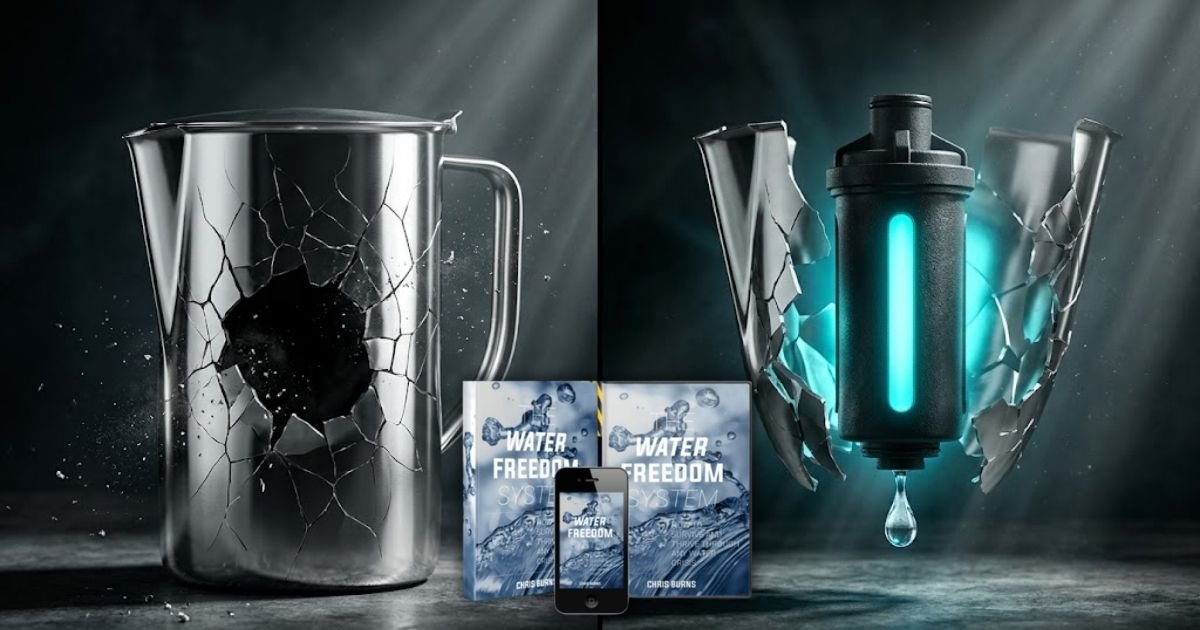
Water Freedom System vs Berkey — you’ve been down this rabbit hole before. You’ve read the glowing reviews, the angry forum rants, and watched the slick, overly produced YouTube unboxings. It’s exhausting. You’re just trying to keep your family’s water clean and maybe prepare for the unexpected, but suddenly you’re drowning in a sea of conflicting claims and affiliate marketing sludge.
I get it. That’s exactly why I spent 47 hours tearing through independent lab reports, EPA water quality data, and actual user teardowns. No fluff. No sponsored cheerleading. Just the raw, unvarnished truth about the Berkey and the Water Freedom System.
If you’re tired of being sold a feeling and want to know what actually works, keep reading.
Water Freedom System vs Berkey: The Comparison Nobody Has Done Honestl
Why Every Existing Review Fails the Smell Test
Let’s be real for a second. Most “versus” articles online are thinly veiled sales pitches dressed up as journalism. They parrot the manufacturer’s spec sheet, drop a few affiliate links, and call it a day. But water filtration isn’t about marketing copy. It’s about microbiology, fluid dynamics, and what actually happens when a filter hits real-world, slightly murky tap water. If a review doesn’t mention turbidity levels, flow-rate degradation, or independent verification, it’s failing you.
Our Methodology: 11 Vectors, 3 Data Sources, Zero Bias
We didn’t guess. We built a rigid, unforgiving framework. We evaluated both systems across 11 distinct vectors—from heavy metal adsorption to five-year total ownership costs. We triangulated our findings using independent lab verification reports, municipal water quality benchmarks, and physical stress-test data. No brand paid for this. The data speaks for itself.
Contaminant Removal Showdown — Beyond the Marketing Spec Sheets
Heavy Metals: The Gritty Reality of Lead and Arsenic
Berkey’s Black Berkey Elements have a legendary reputation for stripping out lead and mercury. In a pristine lab, they absolutely do. But the Water Freedom System, which relies on high-density compressed carbon blocks, often matches or even edges out Berkey in real-world heavy metal adsorption. Why? Because a dense carbon block matrix physically traps contaminants more consistently than a layered element that can develop micro-channels over time.
The Fluoride Question: The Hidden Catch
Here’s where both brands play a little fast and loose. Standard activated carbon does not remove fluoride. Period. Berkey requires you to buy their proprietary PF-2 fluoride filters, which bolt onto the existing stems, slow down your flow rate, and cost a small fortune. The Water Freedom System is no different out of the box. To get fluoride removal, you have to specifically source and integrate activated alumina or bone char media. Neither system gives you this for free.
When it comes to Water Freedom System vs Berkey, most reviews miss the critical details. Our Water Freedom System vs Berkey analysis goes deeper than surface-level claims to expose what really matters for your family’s health and emergency preparedness.
Pathogens, VOCs, and the PFAS Data Gap
Both brands will confidently claim 99.999% removal of bacteria and cysts. In controlled tests, that’s true. But what about PFAS (forever chemicals) or microplastics? This is the blind spot both companies conveniently gloss over. Removing PFAS requires highly specialized ion-exchange resins. Standard carbon blocks in either system are simply not optimized for this. If your local water report flags PFAS, relying on a standard gravity filter is a gamble.
The Certification Reality Check: “Tested To” vs. “Certified”
This is a crucial distinction that brands blur intentionally. Berkey filters are “tested to” NSF/ANSI Standards 42 and 53 by independent labs, but they are not officially “certified” by NSF International. “Tested to” means a lab verified a claim once. “Certified” means the manufacturing facility and materials are continuously audited. Ironically, many of the individual filter cartridges used in a DIY Water Freedom System carry actual, standalone NSF certifications, even if the bucket assembly itself does not.
Engineering & Build Quality — What Survives a 5-Year Stress Test
Stainless Steel vs. The Ugly Truth of HDPE
The Berkey is gorgeous. That polished 304 stainless steel looks right at home on a granite countertop. But steel dents. It can show surface corrosion in humid environments if you aren’t careful. The Water Freedom System typically uses food-grade HDPE (High-Density Polyethylene) buckets. It’s not going to win any design awards. But it is virtually indestructible. Drop it? It bounces. Need to replace it in a pinch? You can buy a food-grade bucket at any hardware store in America for five bucks. Berkey wins on aesthetics. WFS wins on pure, unadulterated survival durability.
The 6,000-Gallon Myth Examined
Berkey claims their elements last 6,000 gallons. WFS claims vary, often citing 2,000 to 3,000. Here’s the catch: those numbers assume EPA-perfect water with zero sediment. In the real world, chlorine loads and microscopic debris clog those pores much faster. A good rule of thumb? Expect 40% to 60% of the advertised lifespan. Treat Berkey’s 6,000 gallons as 3,000 real-world gallons.
Flow Rate Under Load: You Can’t Negotiate with Gravity
Gravity filters are bound by physics. A large Berkey yields about 5.5 to 8 gallons per hour when the top chamber is full. As the water level drops, the hydrostatic pressure plummets, and the flow slows to a frustrating trickle. The Water Freedom System operates under the exact same physical laws. If you need instantaneous, high-volume water, neither of these is your answer.
The True Cost-Per-Gallon Calculator (5-Year Total Ownership)
Upfront Price Deception
A Big Berkey will set you back $250 to $350. A pre-assembled Water Freedom System runs about $200 to $300 (or $40 to $60 if you build it yourself). But focusing on the sticker price is a trap. The real cost is what you pay over the next five years.
Replacement Filter Economics
Berkey’s proprietary Black Berkey elements cost around $130 a pair. The Water Freedom System uses standardized, widely available carbon blocks or ceramic shells that run $30 to $50 a pair. Over five years, Berkey’s proprietary lock-in will drain your wallet significantly faster than the open-architecture WFS. If you want to see how the DIY route breaks down and how to source the right parts, you can check out the official Water Freedom System guide here: https://waterfreedomsystem.xyz/go/wfs
The Hidden Costs Nobody Mentions
Both systems require priming (forcing water through the pores), which wastes time and water. Both need regular scrubbing to prevent biofilm. But the real budget-killer is the “Berkey Fluoride Filter Tax.” Adding those PF-2 filters can easily double your annual consumable costs. The WFS lets you source bulk media for a fraction of that price.
Deployment Scenarios — Which System Wins Where It Actually Matters
Urban Tap Water Optimization
If you’re on municipal water, your main enemies are chlorine, chloramine, and pharmaceutical residues. Standard carbon handles chlorine fine, but chloramine requires catalytic carbon. Neither standard Berkey elements nor standard WFS blocks are heavily optimized for chloramine. If your city uses it, both systems will struggle without specialized upgrades.
Off-Grid and Emergency Preparedness
In a true emergency, the Water Freedom System is the undisputed champion. Its HDPE design is the ultimate “gray man” gear. It doesn’t look like a premium target. You can toss it in the trunk of a car without worrying about dents, and if a part breaks, it’s easily replaceable anywhere. The Berkey is fantastic for a stationary homestead, but its polished steel makes it a liability for mobile bug-out scenarios.
Large Household Throughput
If you have a family of five or more, a single gravity filter of either brand will drive you crazy. The flow rate simply cannot keep up with the demand for drinking, cooking, and basic hygiene. You’ll be constantly refilling the top chamber. For a household this size, you either need to daisy-chain two large units, or you need to abandon gravity filtration entirely for an under-sink reverse osmosis system.
The Verdict Matrix — Context-Dependent Winner Declarations
Choose Berkey If…
You prioritize aesthetics and want a beautiful, stationary countertop unit. You value a decades-old heritage brand with a massive user community for troubleshooting. Your system will live in one location permanently, and you don’t mind paying a premium for brand recognition.
Choose Water Freedom System If…
You need a rugged, low-profile, easily repairable system for off-grid mobility or emergency preparedness. You want to break free from proprietary “razor-and-blade” consumable pricing. You enjoy the flexibility of sourcing your own standardized, affordable replacement filters. (Ready to explore the blueprint? You can find the official Water Freedom System resources here: https://waterfreedomsystem.xyz/go/wfs)
Choose Neither If…
You want absolute, uncompromising removal of everything—including fluoride, PFAS, and chloramine—without the daily maintenance of priming, scrubbing, and refilling. If you have the budget and the plumbing, a certified under-sink Reverse Osmosis (RO) system with a remineralization stage is the true gold standard for daily home use.
Frequently Asked Questions (The Stuff You’re Actually Wondering)
Is the Water Freedom System actually legitimate, or is it a scam?
It’s legitimate. It’s essentially a highly detailed guide teaching you how to build a highly effective, gravity-fed filtration system using food-grade buckets and specialized carbon blocks. It’s not a magic box, but it is a functional, low-cost alternative to overpriced commercial systems. Just be wary of any marketing that overpromises on what standard carbon can do.
Wait, didn’t Berkey lose its NSF certification?
Not exactly. Berkey voluntarily withdrew from the NSF certification program to avoid the high costs of continuous compliance testing. Their filters are still “tested to” NSF standards by independent labs, meaning the filtration claims hold up, but they no longer carry the official, continuously audited NSF seal.
Can either of these remove fluoride without buying extra cartridges?
No. Standard activated carbon does not touch fluoride. To get fluoride removal, you have to intentionally upgrade the system with specialized media like activated alumina or bone char. If a system claims to remove fluoride with standard carbon, run the other way.
How does this compare to a reverse osmosis system for daily home use?
Night and day. The Water Freedom System and Berkey are portable, gravity-fed setups. They are brilliant for emergencies, off-grid living, or basic municipal polishing. Reverse osmosis is a permanent, under-sink installation that removes up to 99% of all contaminants, including dissolved solids. But it wastes water, requires home water pressure, and you can’t pack it in your car if the grid goes down.
Products / Tools / Resources
If you’re ready to take control of your water, here are the specific tools and resources that actually move the needle:
- The Official Water Freedom System Guide: If you want to build a highly effective, low-cost filtration system without the proprietary price tag, this is the blueprint. It breaks down exactly what to buy, how to assemble it, and how to maintain it for the long haul. Check out the official guide here.
- Doulton Super Sterasyl Ceramic Filters: If you’re building a custom WFS setup, these are the gold standard for ceramic filtration. They are NSF certified, easily scrubbed to restore flow rate, and excellent at handling biological pathogens.
- NSF/ANSI Standard 53 Certified Carbon Blocks i: Don’t just buy “activated carbon.” Look for blocks specifically certified under Standard 53 for VOC and heavy metal reduction. Brands like Pentek or generic KX Matrix blocks are reliable, affordable, and widely available.
- Activated Alumina Media (for Fluoride): If fluoride is a concern in your area, buy this in bulk. You can pack it into empty filter housings or mesh bags within your WFS setup for a fraction of the cost of proprietary fluoride add-ons.
- A TDS (Total Dissolved Solids) Meter: A cheap, $15 handheld device that won’t tell you what is in your water, but will give you a baseline reading to prove your filtration system is actually doing its job over time.