Look into pulling clean drinking water straight out of thin air, and you hit a fork in the road almost immediately.
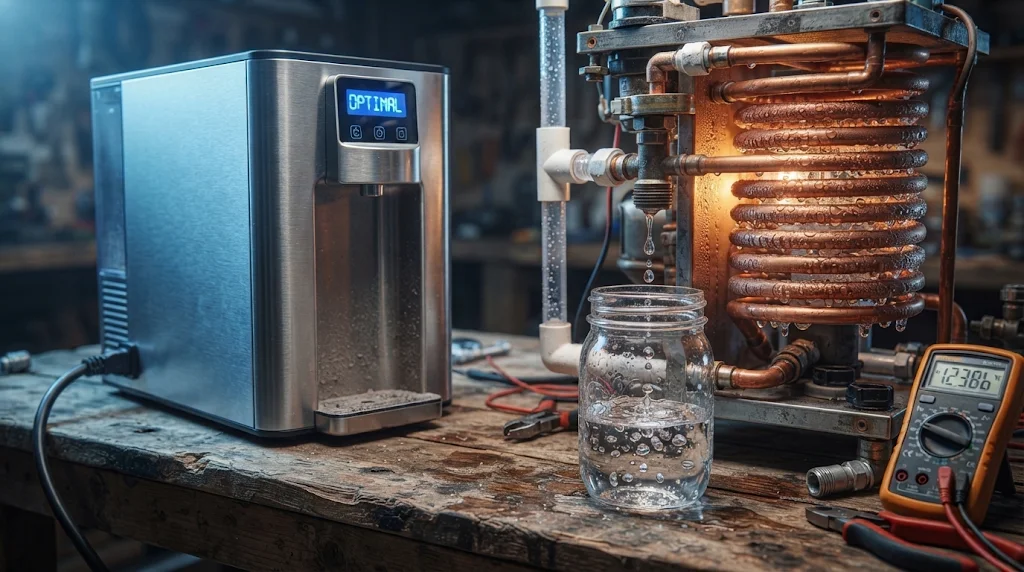
On one side sits the sleek, plug-and-play commercial or consumer atmospheric water generator (AWG)—a finished, factory-built appliance promising filtered water at the push of a button for a four-figure price tag. On the other sits the Water Freedom System—a low-cost digital blueprint from Chris Burns showing you how to cobble together your own air-to-water rig out of PVC piping, off-the-shelf fittings, and basic refrigeration guts.
Both obey the exact same laws of thermodynamics. Yet staring at those two options tends to trigger a very specific, nagging doubt: Do you drop thousands of dollars on a sealed factory machine that might turn into a heavy paperweight the moment supply chains stall, or do you buy a set of DIY plans that could sit unopened in your downloads folder if the build turns out messier than advertised?
Let’s cut past the sales copy on both sides. By putting Atmospheric Water Generator vs. Water Freedom System head-to-head across engineering reality, true ownership math, climate limits, and off-grid resilience, you can pick a water strategy without second-guessing yourself later.
Architecture & Engineering: How Factory AWGs Differ from the Water Freedom System
Even though both setups pull moisture by chilling humid air past its dew point, their physical builds come from two completely different worlds: turnkey convenience versus modular self-reliance.
Pre-Assembled Refrigeration vs. Modular DIY Blueprint Assembly
Think of a factory atmospheric water generator as a specialized, food-grade dehumidifier married to a multi-stage water purification plant inside one powder-coated steel or ABS cabinet. Behind those panels, engineers have already balanced the compressor tonnage, evaporator coil surface area, fan velocity, and internal reservoir so everything runs as a closed loop. You haul it out of the box, plug it into the wall, and let onboard sensors handle defrost cycles, UV lamps, and tank shutoffs.
The Water Freedom System isn’t a machine at all—it’s a set of build plans. Instead of a 100-pound crate showing up on your porch, you get instructions for assembling a condensation rig using accessible hardware: a small refrigeration compressor or salvaged dehumidifier core, food-grade collection basins, PVC ducting, and external filter cartridges. You become the manufacturer. That means build quality, air seals, and electrical safety rise or fall with your own hands.
Component Sourcing, Maintenance Access, and Repairability on the Field
Where a factory AWG shines on Day 1, it can stumble in Year 3—especially during an extended outage or out on a remote homestead.
- Factory AWG Serviceability: Store-bought AWGs pack proprietary circuit boards, custom-molded tanks, and brand-locked filter cartridges into tight spaces. If a relay fries or a moisture sensor gives up, you’re stuck waiting on customer support, warranty shipping windows, and specialized replacement parts.
- Water Freedom System Serviceability: A DIY rig built from standard hardware-store fittings, universal inline filters, and common cooling cores keeps everything out in the open. Every pipe joint, fan, and wire is right there where you can reach it. If a pump quits or a seal loosens, you swap it out yourself with basic hand tools.
Upfront Cost vs. Long-Term Ownership: Breaking Down the Real Math
Sticker price is where people usually miscalculate—either recoiling at the upfront cost of a factory unit or forgetting that a $40 blueprint still requires hundreds of dollars in actual parts.
Commercial & Consumer AWG Price Tiers vs. DIY Parts & Hardware Spend
Before a single drop of water hits your glass, the real capital outlay looks like this:
| Cost & Ownership Factor | Factory Atmospheric Water Generator | Water Freedom System (DIY) |
| Initial Purchase Price | $1,200 to $4,500+ (home units) | ~$39.95 (digital blueprints & guides) |
| Additional Hardware Spend | $0 (ready out of the box) | $250 to $600+ (compressor/core, tubing, filters, tools) |
| Total Startup Outlay | $1,200 – $4,500+ | ~$290 – $640 |
| Build & Setup Time | Under 30 minutes | 1 to 3 weekends (depending on skill & sourcing) |
| Warranty Protection | 1 to 3 years limited manufacturer warranty | 60-day refund on guide; individual part warranties only |
Yes, the Water Freedom System guide costs less than a tank of gas. Still, once you track down a decent cooling core, a food-safe reservoir, a high-airflow fan, and proper filtration, your real hardware bill lands somewhere between $300 and $650—still a fraction of a factory machine, assuming you don’t mind supplying the weekend labor.
Hidden Costs: Filter Replacements, Power Draw, and Downtime Risk
Once the fans start spinning, ongoing costs take over:
- Electricity Consumption: Turning vapor into liquid takes serious wattage. Factory-built or homemade, a compressor-driven air-to-water rig pulls roughly 300 to 800 watts under load—working out to around 1.5 to 3.5 kWh per gallon of water in moderate humidity.
- Filtration & Sanitization: Water condensed from the air is essentially distilled, meaning it carries zero beneficial minerals and easily picks up dust, pollen, and airborne bacteria clinging to wet coils. Factory machines lock you into proprietary filter packs every 6 to 12 months ($80–$200/year). DIY setups let you run standard inline sediment, activated carbon, and remineralization cartridges ($40–$90/year).
- Downtime Risk: With a factory unit, your headache is waiting on backordered proprietary parts. With a DIY build, your headache is troubleshooting your own handiwork—fixing sluggish drain lines, sealing air leaks around the evaporator, or dialing in sanitization before you ever take a sip.
Performance Across Climates and Off-Grid Power Realities
Neither a $3,000 countertop appliance nor a $40 set of plans can bend atmospheric physics. Both live and die by relative humidity, ambient temperature, and available wattage.
Daily Yield Curves Across Humidity, Temperature, and Dew Point Shifts
How much water you actually get depends entirely on how wet the surrounding air is:
- Optimal Conditions (75°F–90°F, 65%–85% Relative Humidity): A mid-sized home AWG rated for 5 to 8 gallons a day will cruise right near its advertised number. A tightly sealed DIY build running a comparable compressor core usually pulls 1.5 to 4 gallons a day.
- Moderate Conditions (65°F–75°F, 45%–60% Relative Humidity): Output drops by roughly 30% to 50% on both sides as compressors run longer cycles to wring moisture out of thinner air.
- Arid / Dry Conditions (Under 30% Relative Humidity): Both factory appliances and DIY rigs hit a hard thermodynamic wall. Once the dew point sinks near or below freezing, standard coils yield barely a trickle and risk icing over completely. (If you live somewhere arid, check our deep-dive stress test on whether the Water Freedom System works in dry climates before spending a dime on air-to-water gear.)
Running on Solar, Inverters, and Grid-Down Backup Power
If emergency preparedness or off-grid living is driving your search, electrical behavior matters far more than brushed-steel housing:
- Factory AWGs pack digital control boards, automatic UV lamps, and high-inrush compressor starts that demand a pure sine wave inverter and a hefty solar + LiFePO4 battery bank—typically at least a 2,000W inverter and 3 to 5 kWh of storage—just to stay online without tripping faults.
- The Water Freedom System leaves the wiring in your hands. You can size the cooling core to match the solar generator you already own, hook up a simple mechanical humidistat or timer switch so it only runs during peak sun or cool pre-dawn humidity spikes, and avoid wasting battery life on glowing standby screens.
Decision Matrix: Which Setup Fits Your Goals, Skills, and Budget?
Choosing between a factory atmospheric water generator and the Water Freedom System really comes down to which resource you’d rather spend: cash or sweat equity.
When a Turnkey Atmospheric Water Generator Makes More Sense
Go with a factory-built AWG if:
- You want water on Day 1 without spending weekends hunting down parts, gluing PVC, or chasing air leaks.
- You want built-in automated safeguards, like continuous UV recirculation loops, leak shutoffs, and NSF-certified food-grade tanks.
- You live in a humid or coastal climate where steady daily yields actually justify a $1,500+ investment for everyday kitchen drinking water.
- You have dependable grid power or a full-scale home solar array built to carry continuous compressor loads.
When the Water Freedom System Delivers Higher Value and Independence
Go with the Water Freedom System blueprints if:
- You want real emergency backup without draining your savings, keeping total startup spend under $600 instead of tying thousands up in one appliance.
- You enjoy hands-on building and want to know your water setup inside and out so you can fix it yourself when nobody is coming to help.
- You’re putting together a modular off-grid or homestead backup rig that needs to tie into custom solar banks, external gravity filters, or bulk storage barrels.
- You treat air-to-water extraction as a backup layer behind rainwater harvesting and stored water reserves, rather than a 24/7 kitchen dispenser.
Frequently Asked Questions
Is the Water Freedom System actually better than buying a real atmospheric water generator?
Neither wins across the board—they’re built for different people. A factory AWG wins hands-down on effortless daily use, clean aesthetics, and automated multi-stage purification. The Water Freedom System wins if you’re watching your budget, want open-access parts you can repair yourself, and prefer tailoring the build to your own off-grid power setup.
How much water will a DIY build make compared to a store-bought unit?
Since the Water Freedom System is a blueprint rather than a single sealed box, output hinges on the cooling core you use and how humid your air is. In warm, sticky weather (60%+ humidity), a solid DIY build generally pulls 1 to 4 gallons a day, while mid-tier home factory AWGs typically produce 3 to 8 gallons a day.
Can you drink the water straight out of either machine?
Never. Both factory AWGs and homemade rigs pull moisture out of ambient air loaded with dust, mold spores, pollen, and airborne chemicals—and raw condensate lacks essential minerals like calcium and magnesium. Always run harvested water through activated carbon, microbial protection (UV or a 0.1-micron ultrafilter), and a remineralization stage before drinking it.
What’s the biggest mistake people make when picking between the two?
Ignoring local weather data. Dropping $2,500 on a factory AWG—or spending two weekends building a DIY rig—in a region where relative humidity routinely sits below 30% will leave you staring at an empty jug and a fat electric bill. Check your local average dew point and humidity first.
Products / Tools / Resources
- Chris Burns’ Water Freedom System Blueprints: The core digital manual covering parts lists, PVC assembly diagrams, and step-by-step build instructions for DIY atmospheric water extraction.
- Turnkey Home Atmospheric Water Generators (e.g., Watergen, Aquaria, or Genaq): Plug-and-play countertop and freestanding units for buyers who want factory-tested refrigeration and automated purification out of the box.
- Inline Activated Carbon, Ultrafiltration & Remineralization Kits: Essential post-condensation filter stages that strip airborne contaminants and restore balanced minerals and taste to harvested water.
- Digital Hygrometer & Dew Point Monitors: Inexpensive workshop sensors that let you track local relative humidity and dial in exact overnight run windows for maximum yield.
- (such as the EPA Drinking Water Standards
or NOAA Dew Point Guide - Pure Sine Wave Solar Generators & LiFePO4 Battery Banks: Off-grid power storage capable of handling compressor startup surges when the grid goes dark.