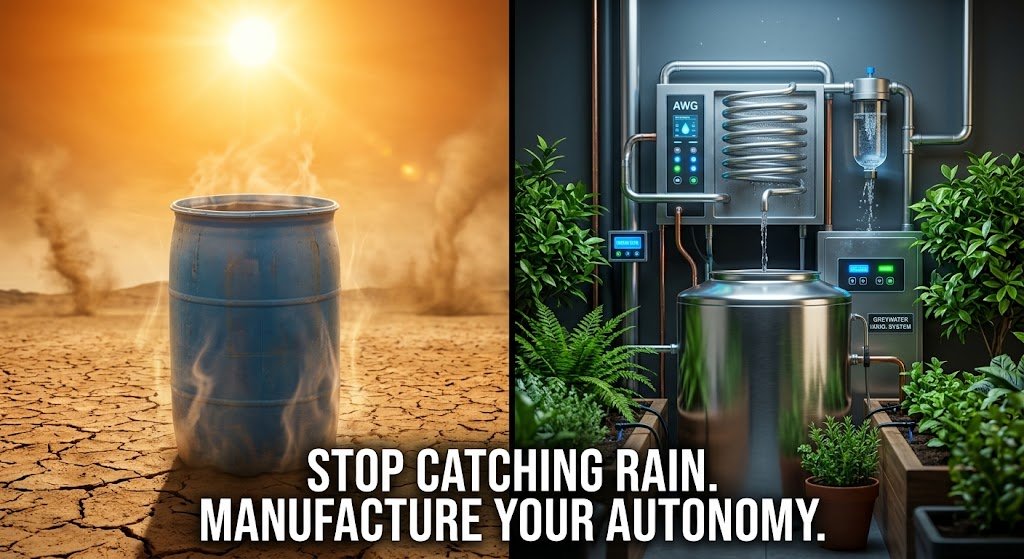
The old math of water security is officially broken. For decades, anyone looking to insulate their property from dry spells followed a predictable playbook: best alternative water supply for drought areas. buy a few rugged cisterns, hook them up to the roof gutters, and wait for the skies to cooperate. It was a comforting setup, a passive ritual that gave a gentle illusion of self-reliance.
But a severe drought doesn’t care about your illusions. When weeks turn into months without a single drop of rain, a rain barrel isn’t a security plan—it is an empty plastic monument to a changing climate.
If you are watching regional water tables plummet, local utility rates skyrocket, or your own well show signs of sputtering, the anxiety is deeply visceral. Water isn’t just an utility; it is the baseline of your autonomy. True safety in an arid landscape requires shifting your entire philosophy. You have to move away from simply catching water when it happens to fall, and transition toward actively generating and cycling your own independent supply.
Below, we strip away the marketing fluff and explore the three most viable engineered alternative water supply systems for true off-grid resilience, ranked rawly by their financial entry point against their real-world, dry-weather output.
The Reality of Dry Climates: Why Traditional Water Storage Fails in a Severe Drought
To understand why the old methods are collapsing, we have to look closely at what happens on the ground when an eco-system truly dries out. The traditional infrastructure of rural homesteads and suburban off-grid setups was designed for an era of predictable seasonal variations. Those days are gone.
[Traditional Catchment/Wells] ──(Vulnerable to)──> [Evaporation / Aquifer Depletion]
│
(Forces Transition To)
▼
[Active Alternative Infrastructure] ──> [AWG Arrays] + [Solar Distillers] + [Greywater Cycling]
The evaporation trap: Why cisterns and rain barrels aren’t enough anymore
It is a cruel, thermodynamic irony: the exact atmospheric conditions that make you desperate for water are the ones actively stealing it from you. When ambient temperatures surge and relative humidity dives, the vapor pressure deficit skyrockets.
If your strategy relies entirely on storing surface or roof water in standard cisterns, you are fighting a losing battle against physics. Micro-gaps in vent caps, slight structural expansions in storage tanks, and thermal transfer through container walls turn your precious reserve into an invisible exit ramp for water vapor.
Worse yet, static water sitting in tanks during prolonged heatwaves becomes a high-risk incubator. As water levels drop, the remaining volume warms rapidly, creating a perfect, stagnant breeding ground for toxic blue-green algae blooms and pathogen colonization. A thousand gallons of contaminated water is just as useless as a dry tank when your health is on the line.
Groundwater depletion and the rising risks of drilling deeper wells
When surface storage fails, the gut reaction for most property owners is simple: call a drilling rig and go deeper into the earth. But treating the local aquifer as an infinite credit card is a dangerous gamble.
As regional droughts persist, industrial agricultural pumping and municipal over-extraction cause water tables to drop at alarming, unprecedented rates. If you attempt to chase a receding water table by deepening a residential well, you face several compounding risks:
- The Financial Sunk Cost: Drilling companies charge by the foot, often with no ironclad guarantee of hitting a high-yield vein.
- The Structural Failure: Deeper pockets of the aquifer are frequently under intense geological pressure, leading to sand infiltration that can chew through expensive submersible pumps in a matter of months.
- The Chemical Reality: The deeper you drill, the older the water is. This deep-horizon water is often heavily loaded with dissolved solids, arsenic, heavy metals, and high salinity, requiring thousands of dollars in secondary multi-stage filtration just to make it fit for basic irrigation, let alone drinking.
Evaluating the Best Alternative Water Supply for Drought Areas
True water independence means decoupling your home from both the municipal grid and the unpredictable whims of the weather. To do this, we look to active engineering.
The following three alternative water supply systems represent the cutting edge of off-grid survivability. Each attacks the problem from a different angle: extraction, purification, and reclamation.
1. Atmospheric Water Generators (AWG): Pulling pure moisture from zero-rain air
Think of an Atmospheric Water Generator as a highly optimized, industrial-grade dehumidifier re-engineered for absolute purity. Even in the middle of a brutal heatwave, the atmosphere functions as a massive, airborne river holding billions of gallons of fresh water in the form of humidity.
An AWG pulls this ambient air through a high-efficiency particulate filter using high-volume intake fans. The air is then forced across a series of ultra-cooled condenser coils. As the air temperature drops past its dew point, water vapor rapidly transitions into liquid droplets, cascading down into a collection manifold. From there, the raw water passes through an intense treatment train—typically involving sediment filters, activated carbon blocks, ultraviolet (UV) sterilization lamps, and mineralizing cartridges to restabilize the pH.
The magic of an AWG is that it bypasses the ground entirely. It doesn’t care if your soil is parched or your local well is bone dry. If there is air to breathe, there is water to harvest.
2. Residential Solar Water Distillers: Turning brackish or gray water into pure drinking supply
If you have access to a water source that is otherwise completely unusable—such as a sulfur-heavy well, a brackish pond, or even a pool of stagnant surface runoff—solar water distillers are your elegant, low-tech salvation.
These systems use a beautifully simple concept: biomimicry of the Earth’s natural hydrologic cycle. In a typical closed-loop solar still, contaminated water is fed into a sealed, insulated basin with a black bottom designed to absorb maximum solar radiation. As the sun bakes the basin, the water heats up and begins to evaporate, leaving 100% of its heavy metals, salts, bacteria, and chemical contaminants behind in the tray.
The clean water vapor rises until it hits a sloped, clear glazing surface cooled by the outside air. The vapor condenses into pure, distilled droplets, trickling down the glass into a clean, dedicated collection trough. It requires zero electricity, features no moving parts to break down when supply chains fracture, and turns the very sun that is drying out your land into the engine of your hydration.
3. Advanced Greywater Recycling Infrastructure: Maximizing every gallon for property survival
If you are only using your water once before sending it down the sewer pipe, you are essentially throwing away your security. Greywater recycling is the art of squeezing every ounce of utility out of the water you already have.
Greywater includes the effluent from your washing machines, bathroom sinks, and showers. It does not include toilet water or heavy kitchen sink grease (which is blackwater). An advanced residential greywater infrastructure automatically diverts this drainage away from the septic tank and into a multi-stage automated treatment system.
[Sinks, Showers, Laundry] ──> [Surge Tank & Lint Screen] ──> [Sub-Surface Bio-Filter] ──> [Safe Sub-Surface Irrigation / Flush Water]
First, the water passes through mechanical screens to catch hair and lint. Then, it enters a sub-surface biological matrix or a pressurized disc filter where beneficial microbes consume organic compounds, soaps, and skin oils. The output is a clear, non-potable stream that can be immediately cycled back into your home to flush toilets or pumped out to keep fruit trees, windbreaks, and defensive perimeters alive during strict local watering bans.
Cost vs. Water Yield: Which Alternative System Fits Your Off-Grid Budget?
A true strategy document demands numbers. To choose the right architecture for your property, you have to look past the initial sticker price and calculate the long-term operational math against your actual geographic constraints.
| Alternative Water System | Average Initial Setup Cost | Operational & Maintenance Overhead | Typical Daily Yield (Peak Conditions) | Yield in Low Humidity (<35% RH) |
| Atmospheric Water Generator (AWG) | $2,500 – $8,500+ | High (Significant electrical draw; annual UV/carbon filter swaps) | 5 to 30 Gallons / Day | Drastically Reduced (Drops by 60-80% as dew point widens) |
| Solar Water Distiller | $300 – $1,500 (DIY vs Commercial) | Extremely Low (Occasional manual basin flushing to clear salt scaling) | 1 to 4 Gallons / Day | Unchanged (Dependent on solar radiation, completely decoupled from humidity) |
| Advanced Greywater Infrastructure | $1,500 – $6,000 | Low to Medium (Periodic pump cleaning; bi-annual filter element cleaning) | 40 to 120 Gallons / Day (Directly tied to indoor use) | Unchanged (Completely internal ecosystem independent of weather) |
Initial setup expenses vs. long-term maintenance overhead
Choosing a system solely on what leaves your bank account on day one is a recipe for system failure. An Atmospheric Water Generator, while incredibly liberating, is an energy hog. If you are running a compressor-based AWG off-grid, you need to budget for the extra solar panels and battery storage capacity required to pull that continuous electrical load during peak hours. Furthermore, you cannot skip the filter cycles; if the UV bulbs burn out or the carbon blocks clog, your pristine air-water quickly turns into a biological risk.
Conversely, greywater systems require a higher degree of initial structural disruption. You or a plumber will need to cut into your home’s drain lines to segregate greywater from blackwater. But once that structural hurdle is cleared, the operational costs are almost negligible—requiring just a small fractional-horsepower pump to move water through the filtration beds.
Daily gallon output comparison in low-humidity environments (Under 35% RH)
This is where many off-grid planners get blindsided. If you read the spec sheet on a commercial AWG, it might proudly promise “10 gallons a day!” What the fine print won’t tell you is that this rating was calculated at an ideal tropical baseline of 80% relative humidity and 85°F air.
When a severe drought settles over an inland basin or high-desert region, afternoon humidity levels routinely drop below 35%. As the air dries out, the efficiency of an AWG drops off a cliff. The cooling coils have to work twice as hard to reach the widening dew point, consuming more kilowatt-hours for a fraction of the liquid output.
In these bone-dry environments, your strategy must pivot toward solar distillation and greywater reclamation. Because a solar still relies entirely on thermal energy to vaporize an existing liquid pool, it works flawlessly even when the outside air is as dry as tinder. Likewise, greywater recycling is completely immune to external atmospheric shifts; its volume is fed entirely by your indoor lifestyle.
Choosing Your Drought-Proof Water Independence Plan
There is no single silver bullet for water scarcity. True resilience lies in redundancy, building a system where the output of one technology covers the environmental vulnerabilities of another.
The hybrid approach: Combining condensation harvesting with closed-loop recycling
If you want an unshakeable, algorithmically defensible off-grid setup, you don’t pick just one system—you engineer a hybrid water loop.
┌─────────────────────────┐
▼ │
[AWG Air Extraction] ──> [Indoor Pristine Use] ──> [Greywater Reclamation] ──> [Sub-Surface Food Production]
In a world-class hybrid ecosystem, an Atmospheric Water Generator runs during the early morning hours when relative humidity is naturally at its daily peak, capturing premium, mineralized water for drinking, cooking, and ice production.
Once that water is consumed, it isn’t discarded. It enters the Greywater Infrastructure, flowing from the sink or shower drain through a automated sediment trap. This reclaimed water is then automatically pressurized and routed to flush toilets or directed out to an underground drip-line matrix to sustain high-calorie root crops and fruit trees.
If your primary well water happens to be highly mineralized or tainted by low aquifer levels, that water is automatically pumped into an array of Solar Water Distillers, which slowly but steadily purifies it into a sterile emergency reserve without adding a single cent to your monthly electrical bill.
By shifting from a linear “use-and-dump” model to a circular, multi-surface harvesting loop, you stop living at the mercy of municipal authorities and changing weather patterns. You become the master of your own hydrologic reality.
Real Queries, Real Answers
Is it legal to harvest alternative water supplies during drought emergencies?
While rainwater collection faces odd restrictions in certain over-allocated Western river basins, extracting moisture from the air via an AWG or recycling greywater on your private property is generally legal and heavily encouraged. However, always check local county health codes regarding greywater plumbing, as some jurisdictions require sub-surface discharge rather than open surface spraying to prevent standing pools.
How do you keep alternative stored water from spoiling over time?
Water generated through distillation or atmospheric condensation lacks residual sanitizers. If stored in a warm tank, it will degrade. To maintain purity, store your yield in food-grade, opaque, UV-stabilized polyethylene tanks. Integrate a small, solar-powered circulation pump that runs the stored volume through an inline ultra-violet (UV) sterilization loop for at least 30 minutes every day to permanently disrupt any bacterial replication.
Can I run an atmospheric water generator entirely on a portable solar setup?
Smaller, countertop or RV-scale AWGs draw roughly 300 to 400 watts of power and can be comfortably run on moderate solar generator systems during peak sunlight hours. However, large-scale residential units that yield 10+ gallons a day require heavy-duty, permanent off-grid solar arrays with dedicated inverter setups and robust lithium iron phosphate (LiFePO4) battery banks to handle the continuous startup surges of the internal compressor.
Products / Tools / Resources
If you are ready to stop planning and start building out your physical water fallback loops, these specific hardware classes and resources form the foundation of a reliable infrastructure:
The Water Freedom System “Water Freedom System”) Blueprint:** The definitive step-by-step digital guide and supply checklist designed to help you construct a highly efficient, home-scale atmospheric water generator using basic parts easily sourced from your local hardware store.
AquaSol Solar Still Glass Panels: High-transmittance, tempered low-iron glass designed specifically to prevent condensation droplet reflection in custom solar water distillation builds.
Matala Filtration Media & Diverter Valves: Clog-resistant biological filter mats and 3-way diversion plumbing valves engineered to safely reroute residential wash drainage.
Sanitizer UV-C Inline Sterilizers: 12V or 110V low-amperage ultraviolet sterilization tubes perfect for keeping static off-grid storage tanks free from bacterial colonization.